

Copay Card Impact Calculator
Understand Your Copay Card Impact
See how copay cards affect your deductible progress and out-of-pocket costs. Many plans don't count copay card payments toward your deductible, which could lead to unexpected costs later.
Important: Most insurance plans use copay accumulator programs that don't count manufacturer payments toward your deductible. This calculator shows what happens when your card expires and your deductible resets to $0.
For many people taking high-cost specialty medications, a copay card can be the difference between staying on treatment and having to stop. These cards, offered by drug manufacturers, cut monthly out-of-pocket costs from hundreds or even thousands of dollars down to just a few. But here’s the catch: copay cards don’t always do what you think they do. If you don’t understand how they work with your insurance, you could be blindsided by a massive bill later - and risk your health because of it.
What Copay Cards Actually Do
Copay cards are designed to help commercially insured patients afford expensive drugs - things like biologics for rheumatoid arthritis, insulin for diabetes, or treatments for multiple sclerosis. The manufacturer pays part of your copay, so you pay less upfront. For example, if your medication costs $8,000 a month and your insurance requires a $1,500 copay, the card might cover $1,400 of that, leaving you with just $100. That sounds like a win.
But here’s what most people don’t realize: that $1,400 from the card doesn’t count toward your deductible or your out-of-pocket maximum. That’s because of something called a copay accumulator program. These programs, now used by 56% of commercial insurance plans, redirect the manufacturer’s money away from your personal cost tracking. So even though you’re paying less each month, your insurance still sees you as having paid $0 toward your deductible.
The Hidden Trap: Accumulator Programs
Imagine you’ve been using your copay card for two years. Your monthly cost is $10. You feel secure. Then, one day, the card runs out - maybe because you hit the annual cap of $20,000, or because the manufacturer stopped offering it. Suddenly, your bill jumps from $10 to $8,000. And your deductible? Still at $0. You haven’t paid a dime toward it.
This isn’t rare. A 2023 study from the NIH found that 68% of patients using copay cards reported better adherence - but nearly half of them didn’t know their card payments weren’t counting toward their deductible. One patient on the National MS Society forum shared: “My $7,500 monthly medication became $10 after using the copay card for two years. When it expired, I discovered my $7,000 deductible was still completely untouched. I had to stop treatment for three months.”
These programs were introduced by insurers to control costs, but the result is often patient harm. The American Medical Association passed a resolution in 2022 opposing accumulator programs, citing a 23.4% higher rate of treatment discontinuation among patients affected by them. When people can’t afford their meds, they skip doses. They delay refills. Sometimes, they stop entirely.
Maximizer Programs: Another Hidden Risk
Some insurers don’t just block manufacturer payments from counting toward your deductible - they actively manipulate your copay to make it look like you’re paying nothing. This is called a copay maximizer program. Here’s how it works: the insurer calculates the maximum amount the manufacturer will pay, then sets your copay to match that exact amount. So if the card covers $1,000 per month, your copay becomes $1,000 - even if your plan’s normal copay is only $200. You pay the same as before, but now you’re not moving closer to your out-of-pocket maximum at all.
These programs are used by 42% of large insurers. They’re sneaky because they make you think you’re getting a free ride. But in reality, you’re stuck paying full price later, with no progress toward coverage. The Specialty Pharmacy Journal found that maximizer programs can increase total annual drug spending for insurers by nearly 19% - meaning the cost gets passed on to everyone else through higher premiums.

Who Can’t Use Copay Cards?
Not everyone qualifies. Copay cards are only available to people with private commercial insurance. If you’re on Medicare or Medicaid, you’re excluded by federal law. This is because of the Anti-Kickback Statute, which bans drugmakers from offering financial incentives to government program beneficiaries. So if you’re on Medicare Part D, you can’t use these cards - even if you’re paying thousands out of pocket.
That leaves a huge gap. Many older adults with chronic conditions rely on expensive specialty drugs. Without copay cards, they’re stuck with full price - or nothing. Some manufacturers offer separate patient assistance programs for Medicare users, but those often require income verification and have long wait times. It’s not the same.
How to Use Copay Cards Safely
Using a copay card doesn’t mean you’re safe. You need to be proactive. Here’s what to do before you even pick up your first prescription:
- Ask your pharmacy: “Does my insurance plan have a copay accumulator or maximizer program?” Don’t assume they’ll tell you. Ask directly. Many pharmacists now track this information - especially in specialty pharmacies.
- Call your insurer. Ask: “Has any of my manufacturer assistance counted toward my deductible or out-of-pocket maximum?” Get the answer in writing. Email them. Save it.
- Check your card’s terms. What’s the annual cap? When does it expire? Is it tied to a specific medication or can you use it for other drugs too?
- Know your deductible. If your deductible is $7,000 and you’ve paid $0 so far, you’re one missed payment away from a financial crisis. Plan ahead.
Specialty pharmacies are starting to use “accumulator alerts” - automated notifications when you’ve used 80% of your card’s value. That gives you 60 days to explore alternatives: switch to a different drug, apply for manufacturer patient assistance programs, or negotiate payment plans. Don’t wait until the card runs out.
What’s Changing in 2026
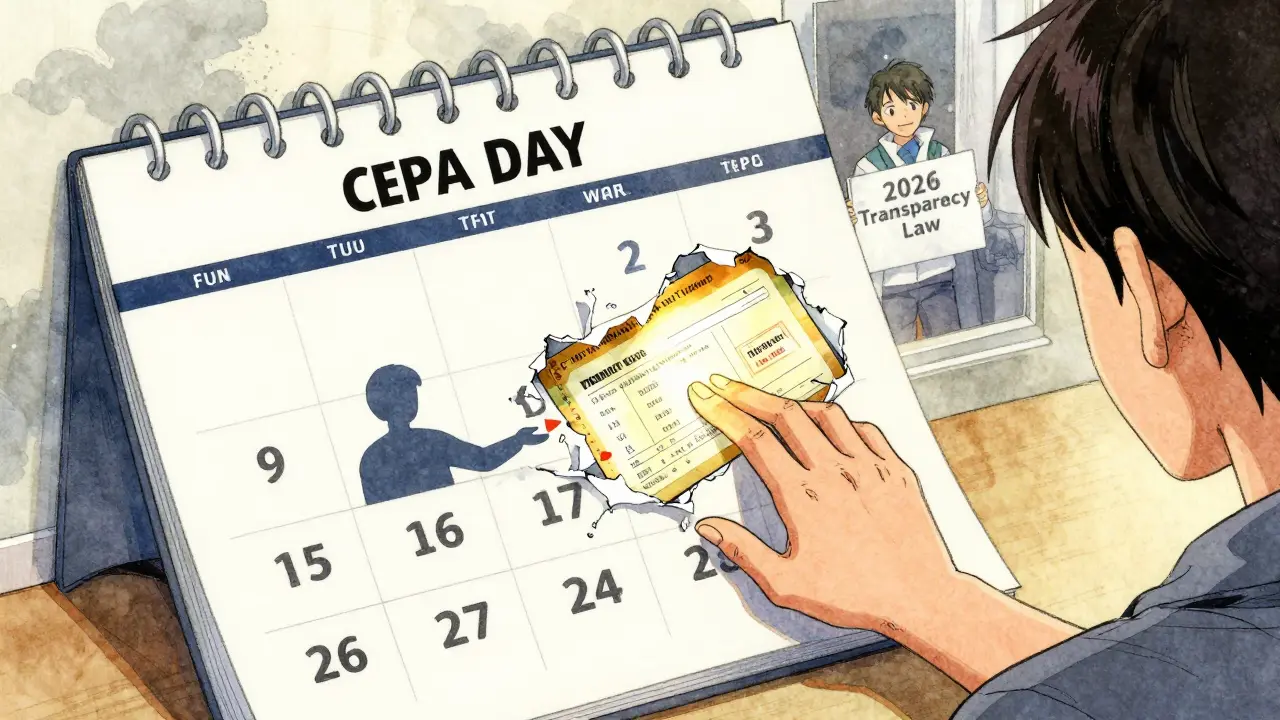
There’s some good news. Starting January 1, 2026, the U.S. Department of Health and Human Services requires insurers to clearly disclose accumulator programs during enrollment and send monthly statements showing your true progress toward your deductible - in plain language, not fine print. This is a big step. For the first time, patients will know exactly where they stand.
Also, CVS Caremark launched transparency dashboards in April 2024 that show real-time deductible progress, even if you’re under an accumulator program. But right now, those are only available to 28% of commercially insured Americans.
Legislation like the Copay Accumulator Moratorium Act, introduced in 2023 and backed by 72 bipartisan lawmakers, could ban these programs for three years while their impact is studied. But pharmaceutical companies spent nearly $29 million lobbying against it in early 2024. The fight isn’t over.
What to Do If You’re Already Caught in a Trap
If you’ve already hit the end of your copay card and are facing a huge bill, don’t panic. Here’s what works:
- Contact the drug manufacturer. Many offer extended assistance programs after the card expires. You might qualify for free or discounted meds based on income.
- Ask your doctor about alternatives. Is there a generic version? A different drug with lower out-of-pocket costs? Sometimes switching helps.
- Apply for nonprofit assistance. Organizations like the Patient Access Network Foundation (PAN) and the HealthWell Foundation offer grants for specialty drug costs.
- Negotiate a payment plan. Most pharmacies and hospitals will let you pay in installments - sometimes interest-free.
Don’t stop your medication unless you have a backup plan. Missing doses can lead to hospitalization, worse symptoms, or permanent damage - especially with autoimmune or chronic conditions.
Bottom Line: Knowledge Is Your Shield
Copay cards aren’t evil. They’ve kept millions of people on life-saving treatments. But they’re not a free pass. The system is designed to look helpful - while quietly shifting costs onto you later. The only way to protect yourself is to understand how your insurance works, ask the right questions, and plan for the day the card runs out.
If you’re on a specialty medication, treat your copay card like a temporary bridge - not a permanent solution. Stay informed. Stay proactive. Your health depends on it.
Can I use a copay card if I’m on Medicare?
No. Federal law prohibits drug manufacturers from offering copay cards to Medicare or Medicaid patients due to anti-kickback rules. However, some manufacturers offer separate patient assistance programs for Medicare beneficiaries, which may provide free or low-cost medications based on income. These require applications and proof of financial need.
Do copay cards count toward my deductible?
Usually not - if your insurance plan uses a copay accumulator program, which is now common. The manufacturer’s payment is redirected and doesn’t count toward your deductible or out-of-pocket maximum. You must ask your insurer directly to confirm. Don’t assume it’s working in your favor.
What’s the difference between an accumulator and a maximizer program?
An accumulator program ignores manufacturer payments entirely - they don’t count toward your deductible. A maximizer program sets your copay to match the maximum amount the manufacturer will pay, so you pay nothing out of pocket - but you also make no progress toward your out-of-pocket maximum. Both prevent you from reaching coverage faster, but maximizers make it look like you’re getting free medication.
How do I know if my plan has an accumulator program?
Call your insurance company and ask: “Do you use copay accumulator or maximizer programs for specialty medications?” Also check your plan documents - they may mention “manufacturer payment not applicable to deductible.” Specialty pharmacies can also check your plan’s rules during prior authorization.
What should I do when my copay card expires?
Start planning 60 days before it runs out. Contact the drug manufacturer for extended assistance, ask your doctor about alternatives, apply for nonprofit grants (like PAN or HealthWell), or negotiate a payment plan with your pharmacy. Never stop your medication without a backup plan - even if the cost spikes.
If you’re taking a specialty medication, the best time to learn about copay cards is before you start - not after you’re hit with a $10,000 bill. Stay informed, ask questions, and never rely on a card as your only safety net.
Ted Conerly
January 9, 2026 AT 21:05Copay cards are a lifeline for so many, but nobody tells you the fine print until you're staring at a $8,000 bill. I had a friend on insulin who thought she was golden for two years - then the card dropped and her deductible was still at zero. She had to choose between rent and refills. This system is broken.
Ashlee Montgomery
January 11, 2026 AT 18:40I’ve been on a biologic for RA for five years. I used my copay card religiously. Never once checked if it counted toward my deductible. Turns out, it didn’t. When it expired, I had to scramble for assistance programs. I wish I’d known sooner. Now I ask every pharmacist: ‘Accumulator or maximizer?’
Ian Cheung
January 12, 2026 AT 06:44They make it look like you’re getting a deal but really you’re just being prepped for a financial gut punch. I call it the ‘Pharma Trap’ - sweet upfront, nightmare later. And the worst part? You don’t even know you’re in it until it’s too late. Stay vigilant. Ask questions. Save every email.
Mario Bros
January 12, 2026 AT 15:27Big Pharma and insurers are playing chess with people’s lives and we’re the pawns. I’m so tired of this. My mom’s on a $12k/month med - copay card got her down to $50. Then it vanished. She cried for three days. We’re not asking for free stuff. We’re asking for honesty.
Jake Kelly
January 14, 2026 AT 01:45For anyone on Medicare - I get it. You’re left out. But there are nonprofits like PAN Foundation and HealthWell. They’re not perfect, but they’ve saved people I know. Apply early. Don’t wait till the card runs out.
Saumya Roy Chaudhuri
January 14, 2026 AT 19:13Oh please. People act like this is some new conspiracy. It’s been this way for a decade. If you can’t read your insurance plan, that’s on you. Stop blaming manufacturers. They’re just giving you a bandaid while the system bleeds you dry.
Lisa Cozad
January 16, 2026 AT 05:00My sister just got diagnosed with MS. I read this post and immediately called her insurer. They admitted they use a maximizer program. She’s now applying for manufacturer assistance before she even fills the script. Knowledge is power - thank you for this.
Jay Amparo
January 16, 2026 AT 13:41As someone from India who’s seen healthcare collapse under profit motives, this hits hard. The U.S. system turns medicine into a gamble. I’ve watched friends die because they couldn’t afford their meds. Copay cards aren’t charity - they’re a temporary fix in a broken machine. We need systemic change, not just better warnings.
Jake Nunez
January 17, 2026 AT 07:46My cousin is on Medicare. She’s paying $2,000 a month for her drug. No card. No help. She’s on a payment plan with her pharmacy - $300/month. It’s killing her savings. Why are people on government insurance treated like second-class patients? This isn’t justice.
Dwayne Dickson
January 17, 2026 AT 11:31It’s not just accumulator programs - it’s the entire pharmacoeconomic architecture that’s designed to externalize cost onto vulnerable populations. The industry’s lobbying expenditures dwarf public health funding by orders of magnitude. This is structural violence masked as market efficiency.
McCarthy Halverson
January 17, 2026 AT 11:54Ask your pharmacist. Call your insurer. Save the emails. Do it now. Don’t wait.
Bradford Beardall
January 19, 2026 AT 05:13I work in a specialty pharmacy. We’ve started putting ‘Accumulator Alert’ stickers on copay card envelopes. We tell patients: ‘This ends in 60 days. Here’s what to do.’ It’s small, but it helps. More pharmacies need to do this.
Faith Edwards
January 20, 2026 AT 06:20One must lament the moral degeneracy of a system wherein the very entities entrusted with healing are complicit in the financial predation of the infirm. The proliferation of accumulator programs represents not merely a fiscal maneuver but a metaphysical betrayal - a perversion of the Hippocratic ethos into a ledger of exploitation. The patient, once the sacred center of care, has been reduced to a line item in an actuarial table.
Christine Milne
January 21, 2026 AT 13:35Why are we even talking about this? If you can’t afford your meds, maybe you shouldn’t be on them. The government should just cover everything. But no - we let people sign up for expensive plans and then cry when the bill comes. This isn’t a crisis. It’s personal irresponsibility.