
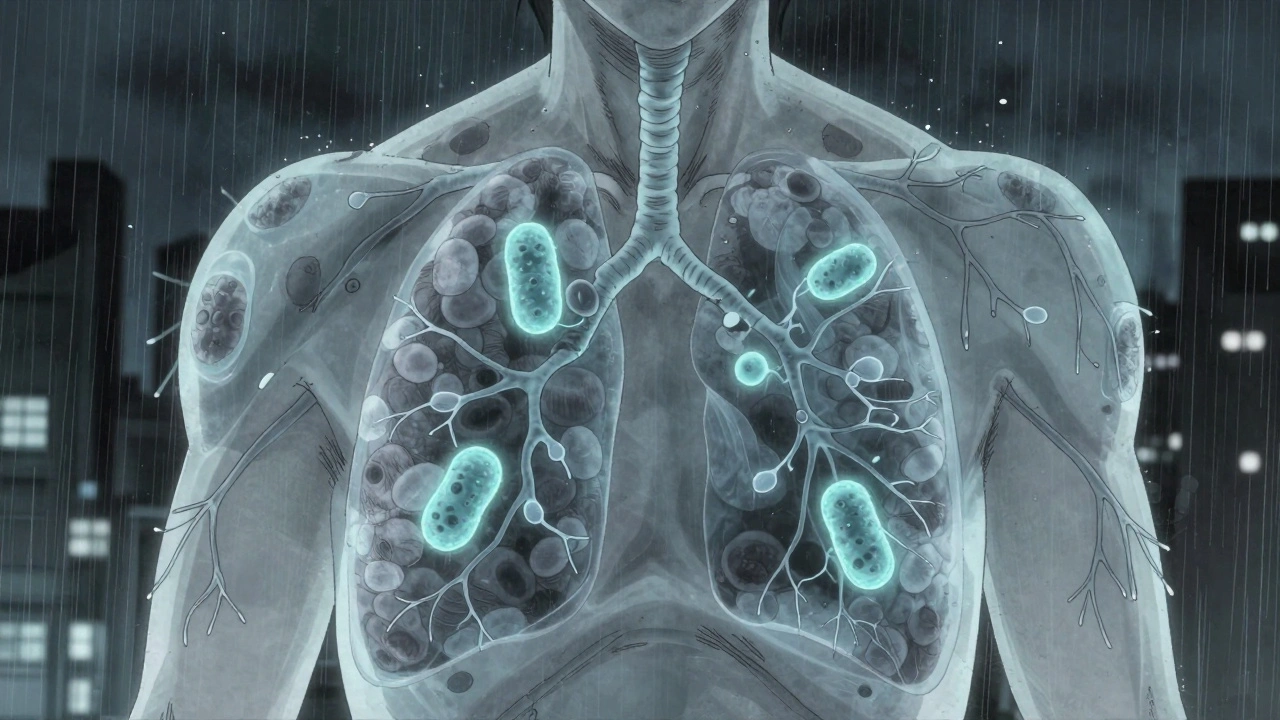
Most people don’t realize that having tuberculosis doesn’t always mean you’re sick. You could be infected with the bacteria and feel perfectly fine - no cough, no fever, no weight loss. But that doesn’t mean you’re safe. This is the quiet danger of tuberculosis: it hides in plain sight.
What Is Latent TB Infection?
Latent TB infection means the bacteria that cause tuberculosis - Mycobacterium tuberculosis - are alive in your body, but they’re not doing anything. They’re sleeping. Your immune system has them locked down in tiny clusters called granulomas, usually in your lungs. You don’t feel sick. You don’t cough. You can’t spread it to anyone else. And your chest X-ray looks normal.This isn’t rare. About one-quarter of the world’s population has latent TB. In Australia, it’s most common among people born in countries with high TB rates, like India, Indonesia, the Philippines, or parts of Africa. If you were exposed years ago and never got tested, you might still be carrying it.
The only way to know you have latent TB is through a test. Two main options exist: the tuberculin skin test (TST), where a small amount of fluid is injected under your skin, or the interferon-gamma release assay (IGRA), a blood test. Both check if your immune system remembers the TB bacteria. A positive result doesn’t mean you have active disease - it just means you’ve been exposed and the bacteria are still there.
Here’s the catch: 5 to 10% of people with latent TB will eventually develop active disease in their lifetime. That risk jumps to 10% per year if you have untreated HIV. Other high-risk groups include people on immunosuppressants, those with kidney failure, or anyone who’s recently been infected (within the last two years).
When Latent TB Becomes Active Disease
Active TB happens when the bacteria wake up. Your immune system can’t keep them under control anymore. They start multiplying, destroying lung tissue, and spreading through your body. This is when symptoms show up - and when you become contagious.The most common sign is a cough that lasts more than three weeks. It doesn’t come and go. It gets worse. You might cough up mucus, sometimes with blood. Other signs include night sweats so heavy you need to change your sheets, unexplained weight loss, fever that comes and goes, and constant tiredness. Some people feel chest pain when they breathe or cough.
Unlike latent TB, active TB shows up on a chest X-ray. You’ll see spots, shadows, or holes in the lungs. But the real confirmation comes from lab tests. Sputum samples - the mucus you cough up - are checked under a microscope or tested with a nucleic acid amplification test (NAAT) to find the bacteria’s DNA. A culture can take weeks, but it’s the gold standard because it tells doctors which drugs the bacteria are resistant to.
People with active TB can spread the disease through the air. Every cough, sneeze, or even loud talk releases tiny droplets. You don’t need to be in close contact for long - just sharing a room for hours increases risk. That’s why hospitals isolate patients with suspected TB and why public health teams track contacts.
How TB Is Treated: Latent vs. Active
Treatment for latent and active TB couldn’t be more different.For latent TB, the goal is simple: kill the sleeping bacteria before they wake up. The standard treatment is isoniazid (INH) taken daily for nine months. It’s cheap, effective, and widely used. But sticking to it for that long is hard. Side effects like nausea, fatigue, or liver problems make people quit. That’s why newer options exist: rifampin for four months, or a once-weekly combo of isoniazid and rifapentine for three months. The three-month option has higher completion rates and is now recommended by the WHO and CDC for most adults.
Active TB is a full-on medical battle. You need at least four drugs at once for the first two months: isoniazid, rifampin, pyrazinamide, and ethambutol. This multi-drug approach prevents resistance. After two months, you drop pyrazinamide and ethambutol, and keep isoniazid and rifampin for another four to seven months. That’s six to nine months of pills - sometimes more if the strain is drug-resistant.
Why so many drugs? Because TB bacteria are tricky. They grow slowly and hide inside cells. One drug won’t touch them all. If you miss doses or stop early, the surviving bacteria become stronger. That’s how multidrug-resistant TB (MDR-TB) forms - a nightmare scenario where standard drugs don’t work. Treating MDR-TB can take 18 to 24 months with harsher pills and injections.
To make sure people finish treatment, many clinics use directly observed therapy (DOT). A nurse or health worker watches you swallow each pill. It sounds strict, but it saves lives. In Melbourne, DOT is standard for all active TB cases. It’s not about control - it’s about stopping the spread before it becomes untreatable.

Side Effects and Monitoring
TB drugs are powerful, and they hit your liver hard. Isoniazid and rifampin are the biggest culprits. That’s why blood tests for liver enzymes are done every month during treatment. If your liver enzymes spike, your doctor might pause treatment or switch drugs.Other side effects include orange-colored urine (from rifampin), tingling in hands or feet (from isoniazid), and blurry vision (from ethambutol). Most are manageable. But if you get yellow skin, dark urine, or severe nausea, call your doctor immediately. Liver damage from TB meds can be life-threatening if ignored.
For latent TB, side effects are usually mild. But if you’re over 35, your doctor might skip isoniazid and go straight to rifampin or the three-month combo - it’s safer for your liver.
Who Needs Testing and Treatment?
Not everyone needs to be tested for TB. But if you fall into one of these groups, you should be screened:- People born in or who’ve lived in countries with high TB rates
- People who’ve spent time with someone with active TB
- Healthcare workers exposed to TB patients
- People with HIV, diabetes, or kidney disease
- People taking biologics or steroids for autoimmune conditions
- Homeless individuals or those in group living settings
In Australia, free TB testing is available through public health clinics. If you’re from a high-risk country and moved here in the last five years, you’re often screened during your initial health check. Don’t skip it. Latent TB is easy to fix - until it isn’t.

The Bigger Picture: Why TB Still Matters
Tuberculosis is not a disease of the past. In 2023, it was the second deadliest infectious disease worldwide - after COVID-19. The WHO estimates 10.8 million new cases and 1.3 million deaths that year. Drug resistance is rising. Climate change and overcrowding are fueling outbreaks in cities. And while wealthy countries have low rates, TB thrives where healthcare access is patchy.Here’s what most people don’t know: treating latent TB is one of the most effective public health moves we have. Every person treated for latent TB prevents future active cases - and stops chains of transmission. In Melbourne, targeting latent TB in migrant communities has helped keep local rates low. But it requires testing, trust, and follow-up.
Active TB is treatable - but only if caught early. Delayed diagnosis means more lung damage, longer treatment, and higher chance of spreading it to family, coworkers, or friends. That’s why persistent coughs lasting more than three weeks need medical attention. No matter how minor they seem.
What Comes Next?
Scientists are working on faster tests, shorter treatments, and even a new vaccine. A trial in South Africa showed a vaccine candidate reduced active TB in adolescents by 50%. New drugs like pretomanid and bedaquiline are helping fight drug-resistant strains. But none of this matters if people don’t get tested.TB doesn’t care about your income, your passport, or your job. It only cares if your immune system is distracted. That’s why prevention isn’t just about medicine - it’s about awareness. If you’ve lived in a high-risk area, got a positive skin test years ago, or have a chronic illness, talk to your doctor. Get checked. One test, one pill, one conversation - could stop a lifetime of risk.
Heidi Thomas
December 5, 2025 AT 14:01Latent TB is a myth pushed by Big Pharma to sell more antibiotics. If you feel fine, you’re fine. No need for tests or pills. Stop scaremongering.
Alex Piddington
December 5, 2025 AT 23:06Thank you for this comprehensive and clinically accurate overview. The distinction between latent and active TB is critically underappreciated in public discourse. Early detection remains one of our most effective public health tools, particularly in high-risk populations.
Libby Rees
December 6, 2025 AT 13:57I’m from the Philippines and moved to the US five years ago. They tested me for TB during my visa medical and I had a positive IGRA. My doctor said I didn’t need treatment because I was young and healthy. Now I’m wondering if I should get retested. This article makes me think maybe I should.
Rudy Van den Boogaert
December 7, 2025 AT 07:32My cousin had active TB last year. Took nine months of meds. Lost 30 pounds. Couldn’t work. The DOT program saved her life - nurse came to her house every morning. She said the worst part wasn’t the pills, it was the loneliness. Nobody wanted to be near her. Even her own family stayed away. TB stigma is real and ugly.
Jordan Wall
December 7, 2025 AT 09:51Frankly, the entire TB paradigm is archaic. We’re still relying on 1950s-era diagnostics and regimens while the microbiome revolution and CRISPR-based therapeutics have been sitting on the shelf for a decade. The WHO’s guidelines are essentially a relic of colonial-era epidemiology - outdated, paternalistic, and statistically underpowered. Why are we still using IGRA when whole-genome sequencing of sputum is now commercially viable? #TBReform
Shofner Lehto
December 8, 2025 AT 20:53This is exactly the kind of info people need to hear. If you’re from a high-risk country or work in healthcare, get tested. It’s not a big deal. One blood test. One conversation. Could save your life - or someone else’s.
John Filby
December 9, 2025 AT 05:30Wait so if I had a positive skin test 10 years ago and never did anything, am I still at risk? I thought once you’re tested, you’re just always positive forever? I’m confused lol
Elizabeth Crutchfield
December 9, 2025 AT 21:09i had a cough for like 6 weeks last year and just thought it was allergies. i’m from el salvador. should i go get checked? i’m kinda scared now
Ben Choy
December 11, 2025 AT 07:25My uncle died from MDR-TB in 2018. Took him two years to treat. The side effects were brutal - hearing loss, depression, constant nausea. He was a nurse. He knew everything. Still didn’t survive. Please, if you’re on TB meds, don’t skip a single pill. It’s not just about you.
Emmanuel Peter
December 11, 2025 AT 16:36So let me get this straight - you’re saying we should give 300 million people drugs for a disease they don’t have, just because a test says they might get it someday? That’s not prevention, that’s medical overreach. You’re creating a generation of hypochondriacs on antibiotics. This is how you get superbugs.
Ashley Elliott
December 13, 2025 AT 06:56Thank you for writing this - so clearly, so carefully. I work in a refugee resettlement program, and we see this every day. People arrive from Syria, Somalia, Myanmar… they’re terrified of hospitals. But once they understand: ‘This isn’t a punishment. This is a shield.’ - they say yes. Testing is kindness.
Chad Handy
December 15, 2025 AT 06:47I’ve been reading up on this for weeks now, and honestly, the more I learn, the more I realize how broken our public health system is. Latent TB is like a ticking time bomb in millions of people’s lungs, and we’re just… ignoring it? We spend billions on cosmetic procedures and crypto ads, but when it comes to preventing a disease that kills over a million people a year, we act like it’s a footnote. I’ve been talking to my city council about funding mobile TB clinics. We need to treat this like the emergency it is - not some outdated relic of the 19th century. My mom’s from Guatemala, and she never got tested. Now she’s 62, diabetic, and on steroids for rheumatoid arthritis - and she’s sitting on a sleeping infection that could wake up and kill her. I just want someone to listen. I’m not asking for a miracle. I’m asking for a test. One test. That’s all. Why is that too much to ask?