

Why Your Sleep Position Matters for Sleep Apnea
If you wake up gasping for air, feel exhausted even after eight hours in bed, or your partner says you snore like a chainsaw, your sleep position might be the root cause-not just your weight or age. For many people with obstructive sleep apnea (OSA), the difference between a peaceful night and a night full of breathing interruptions comes down to one simple thing: whether you sleep on your back or your side.
When you lie on your back (supine position), gravity pulls your tongue and soft throat tissues backward, narrowing your airway. Studies show this can reduce airway space by 30-40% compared to sleeping on your side. That tiny change turns a manageable condition into a dangerous one. Some people go from just 5 breathing pauses per hour on their side to 30 or more when on their back. That’s not just snoring-it’s a medical issue.
What Is Positional Sleep Apnea?
Not everyone with sleep apnea has the same problem. About half of diagnosed patients have what’s called positional obstructive sleep apnea (POSA). This means their breathing problems get much worse when they sleep on their back. Doctors define it clearly: if your apnea-hypopnea index (AHI)-the number of breathing pauses per hour-is at least twice as high when you’re on your back compared to your side, you have POSA.
This isn’t just a minor detail. A 2024 review in PMC found that people with POSA have longer apnea events, deeper drops in blood oxygen, and more heart rate spikes when sleeping supine. These aren’t just uncomfortable-they’re risky. The supine position is linked to higher chances of heart strain and even stroke during sleep.
Here’s the good news: if you have POSA, you don’t need to rely solely on a CPAP machine. Positional therapy-training yourself to sleep on your side-can cut your breathing interruptions in half or more.
Side Sleeping: The Natural Fix
Sleeping on your side keeps your airway open. Your tongue stays forward, your throat muscles don’t collapse as easily, and your airway stays wider. The Sleep Foundation calls side sleeping the best position for OSA-and the worst is clearly on your back.
Real-world results match the science. In one study, patients who switched from back to side sleeping saw their AHI drop from an average of 28 to under 5. That’s the difference between severe and mild or even normal sleep apnea. Many patients report snoring stops almost instantly when they roll onto their side. Bed partners notice it too-less noise, fewer complaints, better sleep for both.
It’s not just about apnea. Side sleeping also helps with acid reflux, which often overlaps with sleep apnea. It reduces pressure on the diaphragm and keeps stomach acid where it belongs. For people with both conditions, switching positions can solve two problems at once.
Supine Sleeping: Why It’s Dangerous
Why do so many people still sleep on their backs? It feels natural. Most people start the night on their back and roll around unconsciously. But for those with POSA, every time they roll over, their breathing gets worse.
Supine sleeping doesn’t just increase the number of breathing pauses-it makes each one worse. Apneas last longer. Oxygen levels drop deeper. The brain wakes you up more frequently to restart breathing, even if you don’t remember it. These micro-arousals fragment sleep, leaving you tired even after a full night.
And here’s the hidden danger: if your sleep study doesn’t break down events by position, your doctor might miss how bad your apnea really is. One study found that ignoring position data can understate apnea severity by up to 30%. That means someone with dangerous POSA might be told they have “mild” apnea-and get inadequate treatment.

Positional Therapy: Simple to Advanced Solutions
Changing your sleep position sounds easy-until you’ve tried it. Most people roll onto their back within minutes. That’s where positional therapy comes in.
Basic methods include the tennis ball trick: sew a tennis ball into the back of your pajamas. It’s cheap, accessible, and surprisingly effective. But many users quit within three months because it’s uncomfortable. The ball digs in, disrupts sleep, and can cause soreness.
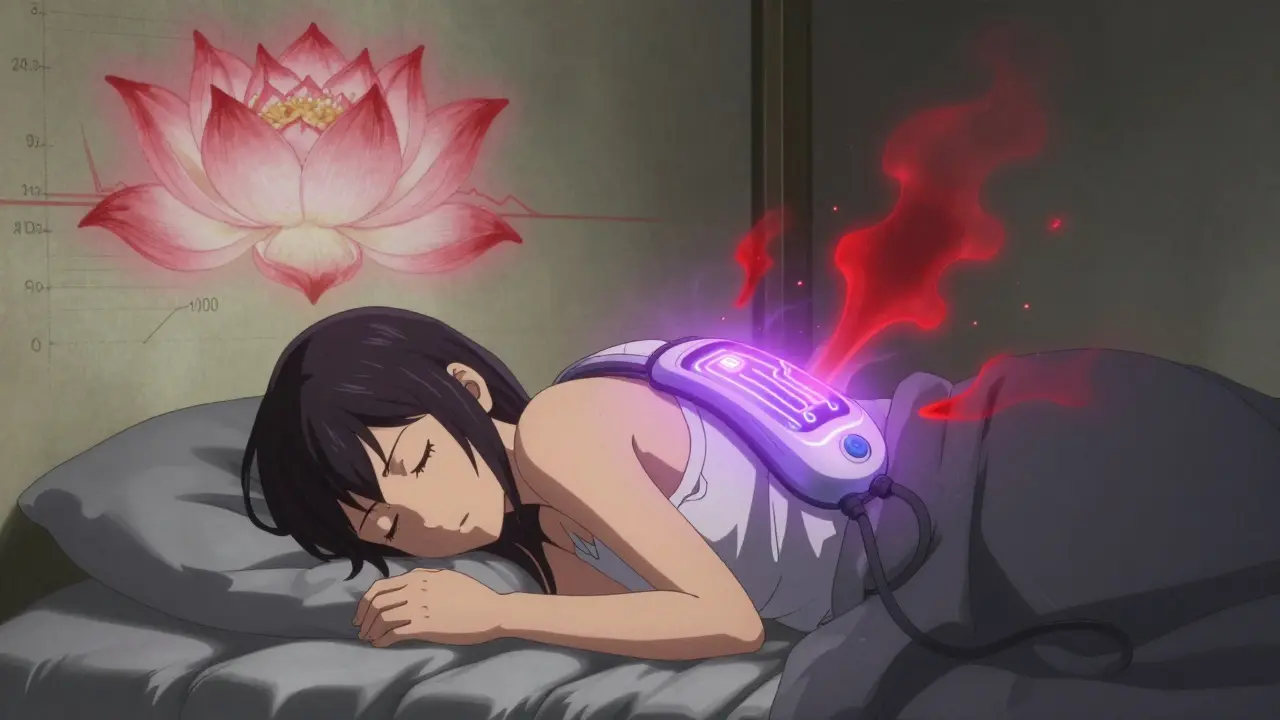
Advanced devices like the NightBalance Sleep Position Trainer (SPT) use gentle vibrations to nudge you back to your side when you roll onto your back. No loud alarms. No waking up fully. Just a soft, persistent nudge that trains your body over time. A 2015 study in the Journal of Clinical Sleep Medicine found SPT users had 68% success rates (AHI under 5), compared to 43% for tennis ball users. Compliance was 30% higher, and quality of life scores improved significantly.
Other options include specialized pillows designed to keep you propped on your side, or smart beds that slowly tilt you into a side position. Prices range from $20 for a wedge pillow to $350-$500 for wearable tech. While the upfront cost seems high, many users find it cheaper than lifelong CPAP supplies or missed workdays from exhaustion.
Positional Therapy vs. CPAP: What Works Better?
CPAP is still the gold standard. It’s the most effective tool for reducing overall apnea events. But here’s the catch: only about half of people stick with it long-term. The mask is uncomfortable. It leaks. It’s noisy. Many quit within six months.
Positional therapy has lower overall effectiveness than CPAP-but far higher adherence. Studies show 35-40% more people use positional therapy consistently than CPAP. And for POSA patients, that’s the key. A treatment that works 90% of the time but is only used 40% of the time is less helpful than one that works 70% of the time and is used 90% of the time.
The American Academy of Sleep Medicine and the American Academy of Family Physicians both recommend positional therapy as a first-line treatment for mild to moderate POSA. For patients who can’t tolerate CPAP, it’s not just an alternative-it’s often the best option.
Who Should Try It?
Not everyone with sleep apnea benefits from positional therapy. It only works if your apnea is truly position-dependent.
To know if you qualify, you need a sleep study that tracks events by position. If your supine AHI is more than double your side AHI, you’re a candidate. If your AHI is high no matter how you sleep, positional therapy won’t help much.
Experts also warn against using it for central sleep apnea (CSA), where the brain fails to signal breathing. While side sleeping may help a bit, the root cause is neurological-not physical. Positional therapy won’t fix that.
And if you have severe OSA (AHI over 30), positional therapy alone usually isn’t enough. But it can still be a powerful addition to CPAP or oral appliances, especially if you struggle with compliance.
How to Get Started
Here’s a simple plan:
- Get a sleep study that includes positional data. Ask your doctor: “Can you break down my AHI by sleep position?”
- If your supine AHI is more than twice your side AHI, you have POSA.
- Start with the tennis ball method. Sew a tennis ball into the back of an old t-shirt. Wear it for a week.
- If it works but is uncomfortable, upgrade to a wearable device like NightBalance or Smart Nora.
- Combine with head elevation (use a wedge pillow) to keep your neck aligned and reduce throat collapse.
- Track your progress: use a sleep tracker or ask your partner if snoring has decreased.
Most people see improvement within two weeks. The goal isn’t perfection-it’s consistency. Even reducing supine sleep from 80% of the night to 20% can cut your apnea events in half.
The Bigger Picture: Beyond Breathing
Positional therapy isn’t just about sleep quality. Better sleep means better heart health, sharper focus, lower blood pressure, and less risk of diabetes and depression. For many, switching positions is the first step toward reclaiming their health without drugs or machines.
It’s also cost-effective. A $30 device can replace thousands in CPAP supplies. A better night’s sleep can mean fewer missed workdays, safer driving, and more energy to enjoy life.
And unlike CPAP, which feels like medical equipment, positional therapy is quiet, invisible, and feels like a natural habit-not a treatment.
Final Thoughts: Your Body Knows the Right Position
If you’ve struggled with sleep apnea and CPAP didn’t stick, don’t give up. You might not need a mask-you just need to stop sleeping on your back.
Positional therapy isn’t magic. But for the right person, it’s one of the most effective, underused tools in sleep medicine. It’s simple. It’s safe. And it works.
Try it. Track it. Give it two weeks. You might be surprised how much better you feel-just by changing the way you lie down.
Jay Powers
January 11, 2026 AT 21:41Man I never thought about sleeping position being this big of a deal until my buddy started using that vibrating belt thing and his snoring just vanished overnight
Eileen Reilly
January 12, 2026 AT 21:49so like... i tried the tennis ball thing and it was a nightmare like i woke up with a bruise on my spine and then i just rolled off the bed lmao
Monica Puglia
January 14, 2026 AT 01:54i switched to side sleeping after my apnea diagnosis and my partner finally stopped leaving the bedroom 😭✨ best decision ever
Cecelia Alta
January 15, 2026 AT 09:01Okay but why is everyone acting like this is some groundbreaking discovery? I’ve been telling people for years that sleeping on your back is the worst thing you can do if you snore. Also, CPAP is a torture device and anyone who says otherwise is either a sales rep or lying to themselves
laura manning
January 15, 2026 AT 11:52According to the 2024 PMC review cited, positional obstructive sleep apnea (POSA) is defined by a supine AHI ≥2× the lateral AHI, with a mean reduction in airway cross-sectional area of 34.7% (95% CI: 31.2–38.1%) in the supine versus lateral position. Furthermore, the 2015 JCSM study demonstrated a 68% success rate (AHI <5) with NightBalance SPT versus 43% with the tennis-ball method, with compliance rates of 79% versus 52% respectively. The economic analysis reveals that, over a 5-year horizon, positional therapy costs $2,100 less than CPAP when accounting for consumables, maintenance, and productivity loss. This is not anecdotal-it is evidence-based.
George Bridges
January 15, 2026 AT 23:35It’s interesting how many of us assume the problem is weight or age, but the real fix can be as simple as how we position our bodies at night. I know someone who went from 40 apneas an hour to under 5 just by using a wedge pillow and a body pillow to stay on their side. No machine. No meds. Just better alignment.
jordan shiyangeni
January 17, 2026 AT 06:32It’s astonishing how many people still cling to the idea that CPAP is the only viable solution when positional therapy has been proven superior in adherence and comparable in efficacy for POSA patients. The American Academy of Sleep Medicine has clearly endorsed positional therapy as first-line treatment for mild-to-moderate POSA, yet primary care physicians continue to default to CPAP without even evaluating positional dependence. This is not just negligence-it’s systemic failure in clinical reasoning. Moreover, the notion that side sleeping is ‘just a trick’ ignores the biomechanics of pharyngeal collapse, which is well-documented in upper airway imaging studies. If you’re still sleeping supine and blaming your mask, you’re not being brave-you’re being dangerously uninformed.
Audu ikhlas
January 17, 2026 AT 08:57USA always think they invented everything. In Nigeria we just sleep on floor and wake up fresh. No fancy pillows no vibrating belts. You people overthink everything
steve ker
January 18, 2026 AT 03:52positional therapy is for weak people who cant handle a mask
Rebekah Cobbson
January 19, 2026 AT 11:08For anyone thinking of trying this-start with the tennis ball method but use a soft hoodie instead of a t-shirt. And track your sleep with your phone for a week before and after. You might be shocked how much better you feel even if you don’t ‘cure’ your apnea completely. Progress > perfection.
Abner San Diego
January 21, 2026 AT 00:34Why do we even need all this tech? Just sleep on your side. That’s it. Stop buying crap. America turned a simple fix into a $500 industry. I don’t need a vibrating belt to tell me to stop rolling over. I need to stop being lazy.