
Simvastatin Interaction Checker
When you take simvastatin to lower your cholesterol, you're not just managing a number on a lab report-you're handling a powerful drug that can turn dangerous if mixed with the wrong things. Even if you've been on it for years without issues, one new prescription, a common antibiotic, or even your morning glass of grapefruit juice could push you into serious danger. The biggest risk isn't from the drug itself, but from what it's combined with-especially at higher doses.
Why Simvastatin 80 mg Is a Red Flag
The 80 mg dose of simvastatin was once seen as a powerful tool for patients with very high cholesterol. But since 2011, the FDA has warned that this dose carries a risk of muscle damage that’s more than seven times higher than lower doses. In clinical studies, about 0.61% of people taking 80 mg developed myopathy-a condition where muscles break down painfully and dangerously. That might sound rare, but when you’re one of those people, it’s life-threatening. Rhabdomyolysis, the worst form of this, can cause kidney failure and even death. That’s why doctors no longer start new patients on 80 mg. The American College of Cardiology now advises against it entirely. Even if you were on it before 2011, your doctor should have already lowered your dose. If you’re still on 80 mg, ask why. There are safer, more effective options now.The Silent Killer: CYP3A4 Inhibitors
Simvastatin is broken down in your liver by an enzyme called CYP3A4. When something blocks that enzyme, the drug builds up in your blood like water backing up in a clogged pipe. That’s where the real danger lies. Strong CYP3A4 inhibitors are the worst offenders. These include:- Antibiotics: clarithromycin, erythromycin, telithromycin
- Fungicides: ketoconazole, itraconazole, posaconazole, voriconazole
- HIV drugs: ritonavir, atazanavir, indinavir, darunavir
- Immune suppressants: cyclosporine, danazol
- Antidepressants: nefazodone
- Heart rhythm drugs: amiodarone, dronedarone
Grapefruit Juice Isn’t Just a Warning-It’s a Trap
You’ve probably heard to avoid grapefruit with statins. But most people don’t realize how dangerous it really is. A single 8-ounce glass of grapefruit juice can increase simvastatin levels in your blood by up to 260%. That’s like taking a 40 mg dose and getting the effect of a 100 mg dose-without even knowing it. And it’s not just grapefruit. Seville oranges, pomelos, and even some grapefruit-flavored sodas or candies can do the same thing. Unlike medications, you don’t get a label or a warning from your pharmacist when you buy a fruit. One study found that 43% of patients on high-dose simvastatin kept drinking grapefruit juice-even after being told to stop. There’s no safe amount. If you’re on simvastatin, skip it entirely. No exceptions.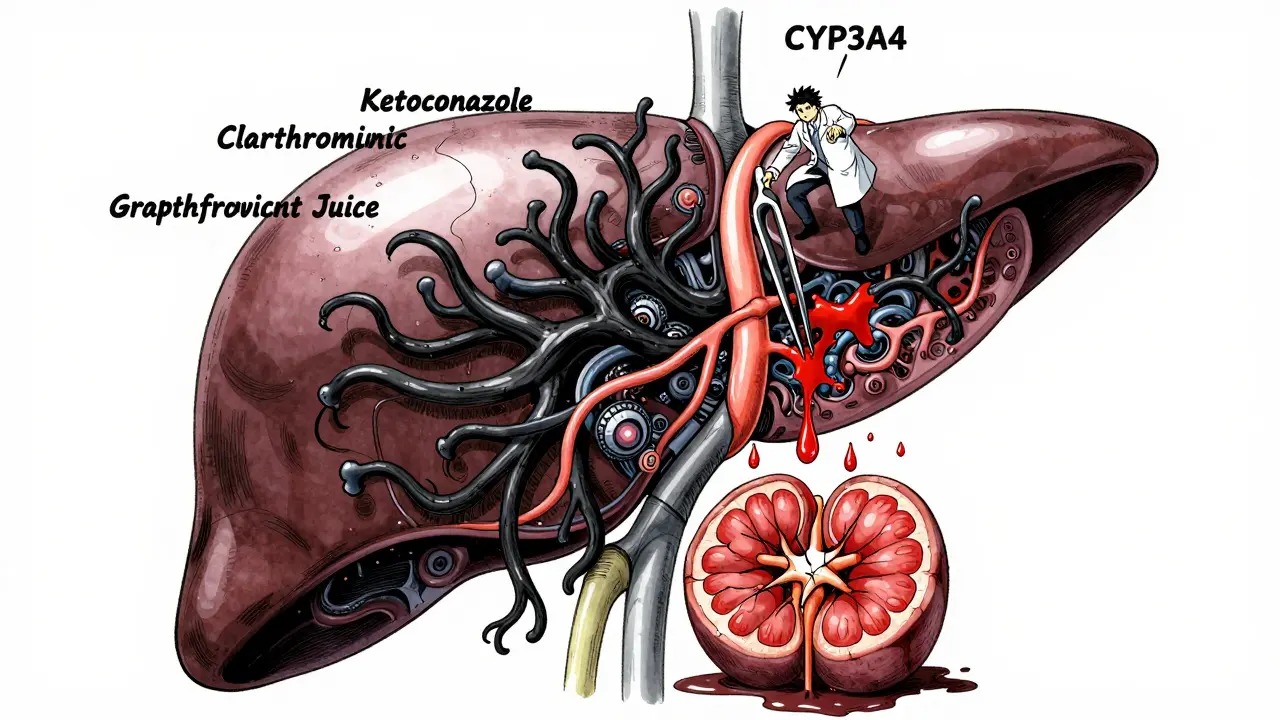
Other Dangerous Mixes You Might Not Expect
It’s not just the big-name drugs. Some common ones can still cause trouble:- Colchicine: Used for gout, it can increase muscle damage risk even at low doses. Many patients don’t realize they’re taking both.
- Fenofibrate or niacin: Often added to statins for stubborn cholesterol, these can stack up the risk of muscle injury.
- Calcium channel blockers: Diltiazem and verapamil (used for high blood pressure) require simvastatin to be capped at 10 mg daily.
- Amlodipine: Even this common blood pressure pill limits simvastatin to 5 mg daily.
What Your Pharmacist Can Do for You
Pharmacists are trained to catch these interactions before you even leave the pharmacy. Studies show that when pharmacists actively screen prescriptions, dangerous combinations drop by 67% in older adults. If you get your meds from multiple pharmacies or fill prescriptions online, you’re increasing your risk. Always use one pharmacy. They’ll flag interactions in real time. If you’re switching from another statin or adding a new drug, ask: “Is this safe with my simvastatin?” Don’t assume it’s fine because it’s over-the-counter or natural.What to Do If You’re Already on a Dangerous Mix
If you’re taking simvastatin and one of these drugs, don’t stop suddenly. Muscle damage can happen fast-sometimes within days. Call your doctor or pharmacist right away. They may:- Switch you to a different statin (like pravastatin or rosuvastatin) that doesn’t rely on CYP3A4
- Lower your simvastatin dose to 5 or 10 mg
- Change the interacting drug to a safer alternative

Testing for Genetic Risk
Some people are genetically more likely to have bad reactions to simvastatin. A gene called SLCO1B1 affects how your body handles the drug. If you have a certain variant, your risk of muscle damage can be 4.5 times higher-even at normal doses. The American Heart Association now recommends genetic testing before starting high-dose simvastatin. It’s not routine yet, but if you’ve had side effects before, or if your family has a history of statin problems, ask your doctor about it. A simple blood test can save you from serious harm.What’s Replacing Simvastatin Today
Thanks to safety concerns, the 80 mg dose is now used in less than 2% of new prescriptions. Even the 40 mg dose is falling out of favor. Doctors now prefer statins that don’t interact as badly:- Rosuvastatin (Crestor): Works well at low doses, less affected by CYP3A4
- Pravastatin (Pravachol): Metabolized differently-safer with other drugs
- Pitavastatin (Livalo): Newer, fewer interactions, good for people on multiple meds
Bottom Line: Know Your Risks
Simvastatin isn’t going away. It’s still widely used because it’s cheap and effective-for the right people. But if you’re on it, you need to be smarter than the average patient. Here’s what to do:- Never take simvastatin 80 mg unless your doctor has a very specific, documented reason
- Avoid grapefruit juice completely
- Tell every doctor and pharmacist you’re on simvastatin-every time
- Get blood tests every 3-6 months to check liver enzymes and muscle damage markers
- If you feel unexplained muscle pain, weakness, or dark urine, stop the drug and get help immediately
Can I take simvastatin with a statin like Crestor?
No. Taking two statins together-like simvastatin and rosuvastatin-doesn’t lower cholesterol more effectively, but it greatly increases the risk of muscle damage. Doctors never combine statins unless under very rare, monitored conditions. Stick to one, and choose the safest one for your other medications.
Is it safe to take simvastatin with over-the-counter painkillers?
Most common painkillers like acetaminophen (Tylenol) are safe. But avoid NSAIDs like ibuprofen or naproxen if you’re on high-dose simvastatin or have kidney issues. They don’t interact directly, but they can stress your muscles and kidneys-making side effects worse. Always check with your pharmacist before combining any OTC meds with simvastatin.
How long after stopping a CYP3A4 inhibitor can I restart simvastatin?
It depends on the drug. For antibiotics like clarithromycin, wait at least 3 days after finishing the course. For stronger inhibitors like ketoconazole or cyclosporine, wait 7-14 days. Your doctor or pharmacist will give you the exact timeline based on the drug’s half-life. Never restart simvastatin without checking first.
Can I drink alcohol while taking simvastatin?
Moderate alcohol (one drink a day for women, two for men) is generally okay. But heavy drinking increases liver stress and can raise the risk of liver damage from simvastatin. If you drink regularly, get your liver enzymes checked more often. If you have existing liver disease, avoid alcohol completely.
Why is simvastatin still prescribed if it’s so risky?
Because for many people, it’s still the most affordable option. Generic simvastatin costs about $4 a month. Newer statins like rosuvastatin or pitavastatin can cost $10-$30. For patients on fixed incomes, cost matters. But doctors now only prescribe simvastatin at low doses (5-20 mg) and avoid it in people on multiple medications. The risk is low when used correctly-and that’s why it’s still in use.
Mark Able
December 19, 2025 AT 08:14I took simvastatin for three years and never knew grapefruit juice could wreck me like that. I drank it every morning like it was water. Now I’m terrified. Thanks for the wake-up call.
Nicole Rutherford
December 19, 2025 AT 18:40Of course you didn’t know. Most people don’t read the fine print until they’re lying in a hospital bed with their muscles turning to mush. You’re lucky you didn’t end up on dialysis. Seriously, if you’re on statins, you owe it to yourself to learn the drug interactions like it’s your job. It’s not rocket science-it’s survival.
Dorine Anthony
December 21, 2025 AT 00:38I’m a pharmacist and I see this all the time. People think if it’s generic or cheap, it’s harmless. Nope. Simvastatin’s the silent killer in medicine cabinets. I always ask patients: ‘Are you eating grapefruit?’ Half say yes. Then I have to explain why they’re basically taking a loaded gun to breakfast.
William Storrs
December 22, 2025 AT 20:41Good post. Seriously. Knowledge is power here. If you’re on simvastatin, don’t just rely on your doctor to remember every interaction. Write it down. Keep a list. Bring it to every appointment. You’re your own best advocate. And yes, ditch the grapefruit. No exceptions. Your muscles will thank you.
Dominic Suyo
December 24, 2025 AT 17:15Oh please. Another fearmongering piece dressed up as ‘medical advice.’ The real danger isn’t simvastatin-it’s the pharmaceutical industry’s obsession with profit-driven guidelines. They pushed 80mg for years, now they’re panicking because someone realized it’s toxic. Meanwhile, the new ‘safer’ statins cost ten times more. Coincidence? I think not.
jessica .
December 25, 2025 AT 15:33they dont want you to know but the FDA is in bed with big pharma and theyre trying to get rid of simvastatin so they can sell you crestor at 30 bucks a pill. grapefruit juice is natural and they hate that. theyll tell you its dangerous but the truth is they dont make money off fruit
Carolyn Benson
December 25, 2025 AT 18:59It’s not about the drug. It’s about control. We’ve been trained to trust pills over our own bodies. Simvastatin isn’t evil-it’s a mirror. It shows how little we understand about our own biology. We swallow chemicals like prayers and pray they don’t kill us. Maybe the real question isn’t ‘what’s dangerous?’ but ‘why do we accept this trade-off?’
James Stearns
December 26, 2025 AT 14:58It is imperative to underscore that the pharmacokinetic dynamics of simvastatin are predicated upon hepatic metabolism via the cytochrome P450 3A4 isoenzyme. Any concomitant administration of inhibitors thereof constitutes a clinically significant drug-drug interaction, potentially precipitating rhabdomyolysis-a condition of profound morbidity and mortality. The FDA’s 2011 advisory was not merely prudent-it was bioethically obligatory.
Chris porto
December 28, 2025 AT 11:05I used to think meds were just numbers on a bottle. Then my dad got hospitalized after taking simvastatin and antibiotics together. He’s fine now, but it scared the hell out of me. I started asking questions. Now I bring a list to every appointment. Turns out, most doctors appreciate it. Turns out, most pharmacists will help you if you just ask. It’s not about being paranoid-it’s about being smart.
Ryan van Leent
December 28, 2025 AT 15:18why do people think their body can handle this stuff i mean come on its a chemical and its in your blood now you want to mix it with juice and painkillers and who knows what else youre asking for trouble
Dorine Anthony
December 29, 2025 AT 23:35Someone above said the FDA is in bed with pharma. I’ve worked in community pharmacy for 18 years. I’ve seen more patients get hurt because they didn’t ask questions than because of conspiracy. The system isn’t perfect-but your pharmacist? They’re the ones who catch the bad combos before you take that first pill. Use them. They’re on your side.