
Potassium Risk Calculator
Salt Substitute Risk Assessment
Use this calculator to assess your risk of hyperkalemia (dangerously high potassium levels) when using potassium-based salt substitutes while taking ACE inhibitors or ARBs.
Most people think swapping regular salt for a "heart-healthy" salt substitute is a simple win. But if you’re taking an ACE inhibitor or ARB for high blood pressure or kidney protection, that little shaker might be silently pushing your potassium levels into dangerous territory. This isn’t theoretical. People are ending up in the ER because of it.
What’s Actually in Those "Lite" Salt Jars?
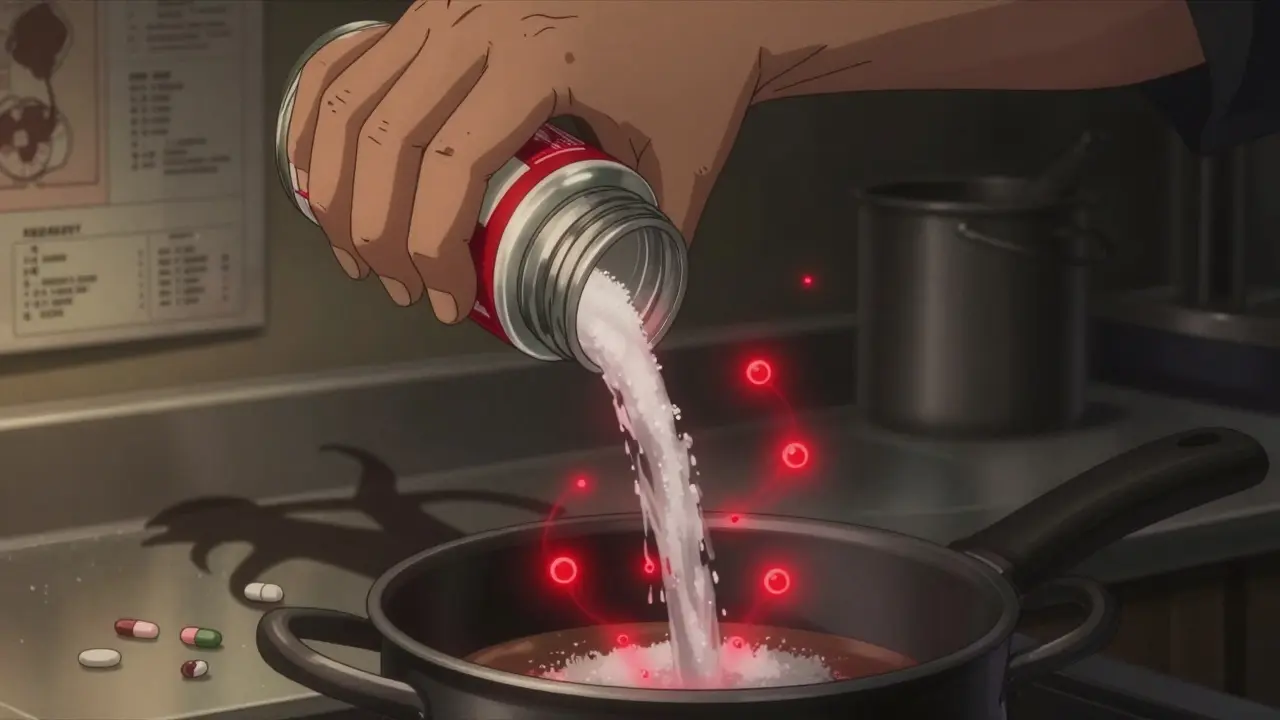
Regular table salt is sodium chloride. Salt substitutes like LoSalt, NoSalt, or Heart Salt replace some or all of that sodium with potassium chloride. That sounds good on paper-less sodium, more potassium, right? The math checks out: a typical "lite" salt is half sodium chloride, half potassium chloride. Pure substitutes can be as high as 66% potassium chloride. That means just one teaspoon can add 400-600 mg of potassium to your diet. For someone with healthy kidneys, that’s fine. For someone on an ACE inhibitor or ARB? It’s a ticking clock.Why ACE Inhibitors and ARBs Are the Problem
ACE inhibitors (like lisinopril, enalapril) and ARBs (like losartan, valsartan) are among the most common blood pressure medications. They work by blocking the renin-angiotensin-aldosterone system, which helps relax blood vessels and reduce fluid buildup. But here’s the catch: they also reduce aldosterone, a hormone that tells your kidneys to flush out potassium. Less aldosterone = less potassium excretion. Add a potassium-rich salt substitute on top of that, and your body starts holding onto potassium like it’s gold.The Numbers Don’t Lie
A 2004 case report in the Journal of the Royal Society of Medicine documented a 72-year-old man who went into cardiac arrest after using LoSalt while on nabumetone and with mild kidney issues. His potassium level hit 7.8 mmol/L-life-threatening territory. Levels above 6.5 mmol/L can cause fatal heart rhythms. The risk isn’t rare. According to the Chronic Kidney Disease Prognosis Consortium, people with chronic kidney disease (CKD) on ACE inhibitors or ARBs who use potassium salt substitutes face a hyperkalemia rate of 8.7 events per 100 person-years. That’s more than ten times higher than the general population.Who’s Most at Risk?
You’re in the danger zone if:- You have chronic kidney disease (eGFR below 60 mL/min/1.73m²)
- You’re diabetic with hyporeninemic hypoaldosteronism (common in 10-20% of diabetics with kidney damage)
- Your serum potassium is already above 4.5 mmol/L
- You’re over 65 and taking multiple medications

Real Stories, Real Consequences
Reddit user "u/KidneyWarrior" posted in October 2023: "Used "Heart Salt" for 3 weeks while on lisinopril. Woke up in the ER with potassium at 6.3. They said I was minutes away from cardiac arrest." A Drugs.com review from a 68-year-old in Michigan: "Switched to potassium salt on losartan. Muscle weakness, fluttering heart. Took me three days to get my levels back down. My doctor said I was lucky." These aren’t outliers. Amazon reviews for popular salt substitutes show 7% of users with self-reported kidney conditions say their doctor told them to stop immediately after bloodwork showed high potassium. Yet, only 3 out of 12 major brands clearly warn about this risk on their labels.It’s Not All Bad News
For people with healthy kidneys, potassium salt substitutes can be a game-changer. A 2025 JAMA Network study of 21,000 people showed a 14% drop in stroke recurrence over five years when using salt substitutes with 25% potassium chloride. The American Heart Association is updating its guidelines to reflect this-conditionally recommending them for those without kidney disease. But here’s the split: 85-90% of people can safely use these substitutes. The other 10-15%? They’re at serious risk. The problem isn’t the salt substitute-it’s the lack of screening, education, and labeling.What Should You Do?
If you’re on an ACE inhibitor or ARB:- Check your last blood test. Was your potassium above 4.5 mmol/L? If yes, avoid potassium salt substitutes.
- Ask your doctor or pharmacist: "Is it safe for me to use salt substitutes?" Don’t assume it’s okay.
- Don’t rely on labels. Most don’t warn you about ACE inhibitors or ARBs. The FDA is working on new rules, but they won’t be in place until 2026.
- Get your potassium checked every 3 months if you’re using one, even if you feel fine.

Alternatives That Actually Work
You don’t need potassium chloride to cut sodium. Try these instead:- Herbs and spices: Garlic powder, onion powder, smoked paprika, cumin, oregano, rosemary. Brands like Mrs. Dash are sodium-free and potassium-free.
- Lemon juice and vinegar: Brightens flavor without adding sodium or potassium.
- Low-sodium broths: Use them in cooking instead of salt.
What’s Changing?
Canada now requires salt substitutes to carry a clear warning: "Contraindicated in patients taking ACE inhibitors." The U.S. FDA proposed similar rules in May 2024. Final rules are expected in Q2 2026. Until then, you’re on your own. Meanwhile, companies like NutraTech Solutions are testing slow-release potassium formulations in Phase 2 trials. These could offer the benefits without the spike in blood potassium. But results won’t be out until late 2026.The Bottom Line
Salt substitutes aren’t inherently bad. But for people on ACE inhibitors or ARBs, they’re a silent killer. The risk is real, measurable, and preventable. You don’t need to guess. Check your potassium levels. Talk to your doctor. And if you’re unsure, skip the substitute. Use herbs. Use lemon. Use vinegar. Your heart will thank you.Can I use salt substitutes if I’m on lisinopril?
Only if your kidneys are healthy and your potassium levels are normal. If you have kidney disease, diabetes with kidney issues, or your potassium is above 4.5 mmol/L, you should avoid potassium-based salt substitutes entirely. Many people on lisinopril don’t realize the risk until it’s too late. Always check with your doctor before switching.
How do I know if my salt substitute has potassium chloride?
Check the ingredient list. If it says "potassium chloride," "KCl," or "potassium salt," it’s a potassium-based substitute. Common brands include LoSalt, NoSalt, and Heart Salt. If it says "sodium reduced" or "lite salt," it likely contains potassium chloride too. If it only lists herbs, spices, or sea salt without potassium chloride, it’s safe.
What are the symptoms of high potassium?
Early signs include muscle weakness, fatigue, numbness, tingling, and nausea. As levels rise, you might feel your heart fluttering or skip beats. Severe cases cause chest pain, irregular heartbeat, or sudden collapse. These symptoms can come on quickly. If you’re on an ACE inhibitor or ARB and notice any of these after using a salt substitute, get your potassium checked immediately.
Do all salt substitutes contain potassium?
No. Only those labeled as "potassium chloride," "lite salt," or "low-sodium salt alternatives" contain potassium. Regular iodized salt, sea salt, kosher salt, and herb-based seasonings like Mrs. Dash contain no potassium chloride. Always read the label-don’t assume.
How often should I get my potassium checked if I’m on an ACE inhibitor?
If you’re on an ACE inhibitor or ARB and use potassium salt substitutes, get your potassium checked every 3 months. If you don’t use them but have kidney disease or diabetes, check at least once a year. Many doctors don’t test routinely unless symptoms appear-but you should ask for it. High potassium often has no symptoms until it’s dangerous.
Are salt substitutes more expensive?
Yes. A 12-ounce container of potassium-based salt substitute costs $2.99-$5.99 in the U.S., while regular iodized salt is $0.99-$1.99. That’s about 1.5 to 3 times more expensive. But if you’re at risk, the cost of a hospital visit or emergency care is far higher. Safer alternatives like herbs and spices cost less and don’t require monitoring.
Why don’t the labels warn about ACE inhibitors?
Because they’re not required to. The FDA doesn’t currently mandate warning labels for potassium chloride in salt substitutes. Only 3 of 12 major brands voluntarily include the warning. Canada made it mandatory in January 2024. The U.S. FDA proposed new rules in May 2024, but they won’t be enforced until 2026. Until then, it’s up to you to know the risk.
Can I use salt substitutes if I have high blood pressure but no kidney disease?
Yes, if your kidneys are healthy (eGFR above 60) and your potassium levels are normal. Studies show these substitutes can lower blood pressure and reduce stroke risk in people without kidney disease. But you still need to get your potassium checked at least once a year, especially if you’re over 65 or take other medications that affect potassium.
LIZETH DE PACHECO
January 1, 2026 AT 14:15Just had my potassium checked last week-4.6. My doc told me to ditch the "lite" salt immediately. I thought it was healthy! So glad I read this. Switched to Mrs. Dash and lemon zest. Tastes better anyway. 🙌
jaspreet sandhu
January 1, 2026 AT 18:34People these days think medicine is a magic pill and seasoning is free. You take lisinopril, you don’t touch anything with potassium unless you’ve got a lab report in hand. It’s not complicated. It’s biology. Your kidneys aren’t superheroes. They’re tired workers. Don’t make them carry extra weight.
Dusty Weeks
January 3, 2026 AT 01:29They’re hiding this on purpose. Big Pharma doesn’t want you to know you can fix BP with lemon and herbs. Salt substitutes are a scam to keep you buying meds. 🤡💊
Kristen Russell
January 3, 2026 AT 02:41My grandma used rosemary and garlic powder. She’s 92, runs marathons (ok, 5Ks), and her BP is perfect. No fancy salts. Just real food. Sometimes the old ways are the safest.
Bryan Anderson
January 4, 2026 AT 22:53This is an excellent, well-researched breakdown. I work in primary care and see this exact scenario monthly. Patients assume "low sodium" means "safe for everyone." The disconnect between consumer perception and clinical reality is staggering. Education is the real missing ingredient here.
Liam George
January 6, 2026 AT 22:31Did you know the FDA has been sitting on this since 2018? They knew. They delayed the warning labels because salt substitute manufacturers donated to their advisory boards. This isn’t negligence-it’s corruption. The 2026 deadline? A distraction. They’ll extend it again. You’re being played.
Olukayode Oguntulu
January 7, 2026 AT 06:33Ah, the great potassium paradox: the mineral that keeps your heart beating is also the silent assassin of the renin-angiotensin cascade. We’ve pathologized sodium while fetishizing potassium as if it were some divine electrolyte from Mount Olympus. The body doesn’t care about your moral labeling of nutrients-it only responds to stoichiometry. Potassium chloride is not a virtue; it’s a pharmacokinetic wildcard when aldosterone is suppressed. You’re not eating a "health food"-you’re dosing yourself with a potassium bolus under the guise of culinary ethics. The irony? The same people who scream about glyphosate will happily sprinkle 600mg of KCl on their eggs while ignoring the fact that their eGFR has been creeping down since 2020.
Lee M
January 8, 2026 AT 06:03People are too lazy to read labels. I’ve seen it a hundred times. Someone buys "NoSalt" because it says "heart-healthy" on the front, never checks the back, and then wonders why they’re dizzy. This isn’t a medical crisis-it’s a literacy crisis. If you can’t read a nutrition label, maybe you shouldn’t be cooking with substitutes. Period.
Matthew Hekmatniaz
January 9, 2026 AT 04:40I’m from Iran-we use a lot of sumac and dried lime in cooking. No salt substitutes needed. Flavor comes from layers, not chemicals. I showed my American coworkers how to use za’atar and pomegranate molasses. They were shocked it tasted better without salt. Maybe the answer isn’t replacing sodium with potassium… but rediscovering real flavor.
Sally Denham-Vaughan
January 10, 2026 AT 08:29My mom used to say, "If it’s in a shaker, it’s probably not helping you." She used herbs, vinegar, and a squeeze of orange. She lived to 94. Just saying.
sharad vyas
January 11, 2026 AT 22:12It’s funny how we fear sodium but worship potassium. Both are just ions. The body doesn’t care if it’s NaCl or KCl-it cares about balance. The real issue is that doctors don’t test potassium often enough. It’s not the salt substitute. It’s the lack of monitoring. We treat symptoms, not systems.
Alex Warden
January 12, 2026 AT 06:27Canada’s got the right idea. If you’re dumb enough to use potassium salt while on blood pressure meds, you deserve what you get. But we should force labels on every jar in America. No more guessing. No more "it’s natural" nonsense. If it can kill you, say it loud. This isn’t a debate-it’s a public health emergency. Stop being polite. Start being clear.