
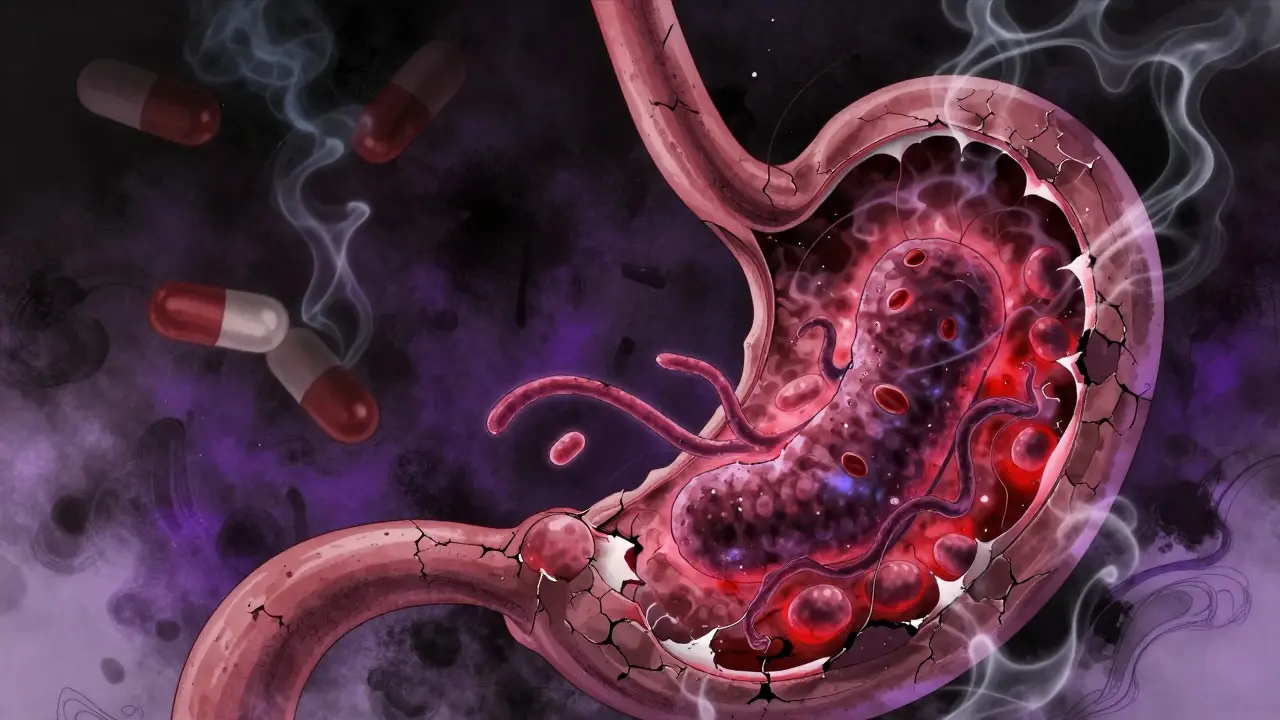
Peptic ulcer disease isn’t just a bad stomach ache. It’s a real break in the lining of your stomach or upper intestine - one that doesn’t heal on its own and can get worse if ignored. Around 8 million people worldwide live with it right now, and for most, the fix is straightforward - if you know what to do. The big shift in how we treat ulcers came in the 1980s, when two Australian doctors proved that a tiny bacterium, H. pylori, was behind most cases. Before that, doctors thought stress and spicy food caused ulcers. They were wrong. Today, we know better - and treatment is more effective than ever.
What’s Really Causing Your Ulcer?
The two biggest causes of peptic ulcers today are H. pylori infection and regular use of NSAIDs like ibuprofen or naproxen. H. pylori is a spiral-shaped bacteria that hides in the mucus layer of your stomach. It doesn’t just sit there - it digs in, weakens your stomach’s natural defenses, and lets acid eat away at the tissue underneath. About half of people with duodenal ulcers and 30-50% of those with stomach ulcers have this bug. It’s not rare. It’s common.
But here’s the twist: NSAIDs are now responsible for more than half of all peptic ulcers. That’s right - the painkillers you take for headaches, back pain, or arthritis are quietly damaging your gut. NSAIDs block protective chemicals in your stomach lining, making it vulnerable. This is especially true for older adults who take them daily. If you’re over 60 and on ibuprofen every day, your risk goes up fast.
Smoking and heavy drinking make things worse. Smoking doubles or triples your risk of developing an ulcer. Drinking more than three alcoholic drinks a day raises your risk by 300%. These habits don’t cause ulcers directly, but they slow healing and make treatment fail. And yes - stress doesn’t cause ulcers, but it can make symptoms feel worse.
How Antibiotics Fix the Root Cause
If H. pylori is the problem, antibiotics are the solution. But you don’t just take one pill. You take a combo - usually two antibiotics plus a proton pump inhibitor (PPI). This is called triple therapy. It’s been the standard for years, and it works - if you stick to it.
Common antibiotic pairs include clarithromycin with amoxicillin, or clarithromycin with metronidazole. You’ll take them for 7 to 14 days, usually twice a day. The PPI (like omeprazole or esomeprazole) helps by lowering stomach acid, so the antibiotics can do their job without being destroyed by acid. It’s not just about killing bacteria - it’s about giving your stomach a chance to heal.
Here’s the catch: resistance is rising. In the U.S., about 35% of H. pylori strains are now resistant to clarithromycin. That means triple therapy fails more often than it used to. New guidelines from the American College of Gastroenterology now recommend quadruple therapy as first-line in many areas. That means adding bismuth (like Pepto-Bismol) to the mix - four drugs total. It’s harsher, but it works better where resistance is high.
Side effects? They’re real. Many people report a metallic taste, especially with metronidazole. Nausea, diarrhea, and bloating are common. But here’s what patients don’t always say: the symptoms get better after the antibiotics stop. And if you finish the full course, your chance of the ulcer coming back drops from 70% to just 10%.
How Acid-Reducing Medications Help You Heal
Antibiotics kill the bug, but acid-reducing meds give your stomach time to repair itself. There are two types: proton pump inhibitors (PPIs) and H2 blockers.
PPIs are the gold standard. They include omeprazole (Prilosec), esomeprazole (Nexium), lansoprazole (Prevacid), pantoprazole (Protonix), and rabeprazole (AcipHex). These drugs shut down the acid pumps in your stomach lining. One dose lasts 24 to 72 hours. That’s why they’re taken once a day - usually 30 to 60 minutes before breakfast. Timing matters. Take them after eating, and they won’t work as well.
H2 blockers like famotidine (Pepcid) and cimetidine (Tagamet) work too, but they’re weaker. They only block acid for 10-12 hours. That’s why they’re mostly used now for mild cases or when PPIs aren’t an option. PPIs heal ulcers faster and are more effective at preventing bleeding.
For NSAID-induced ulcers, the goal is to stop the NSAID if possible. If you can’t - maybe you have arthritis and need daily pain relief - your doctor might put you on a long-term PPI or prescribe misoprostol, a drug that replaces the protective chemicals NSAIDs destroy. It’s not perfect - it can cause diarrhea and cramping - but it keeps ulcers from forming.

What Happens When Treatment Doesn’t Work
Not every ulcer heals on the first try. If your ulcer doesn’t improve after 8 weeks, it’s called refractory. The most common reason? You didn’t take the antibiotics correctly. Skipping doses, stopping early, or taking PPIs with food instead of before meals kills the treatment. Studies show non-adherence is the #1 cause of treatment failure.
Other reasons: antibiotic-resistant H. pylori, continued NSAID use, or smoking. If you’re still smoking while on treatment, your ulcer won’t heal. Same with alcohol. And if you’re still taking ibuprofen for your knee pain? That’s sabotage.
Doctors now test for antibiotic resistance before choosing treatment. In the past, we guessed. Now, we test your stool or breath for the strain you have - and pick antibiotics that actually work against it. By 2025, 60% of H. pylori treatments will be guided by this testing, up from just 15% in 2022.
The New Kid on the Block: Vonoprazan
A new drug called vonoprazan is changing the game. Approved in the U.S. in January 2023, it’s not a PPI - it’s a potassium-competitive acid blocker (P-CAB). It works faster, lasts longer, and blocks acid more completely than PPIs. In trials, it eradicated H. pylori in 90% of patients, compared to 75-85% with traditional PPIs. It’s already standard in Japan and now available here. It’s not yet first-line everywhere, but it’s becoming the new benchmark for success.
Long-Term Risks of Acid Reducers
PPIs are safe for short-term use. But if you’re on them for years - especially at high doses - there are risks. The FDA has issued warnings about possible links to bone fractures, low magnesium, vitamin B12 deficiency, and a rare kidney condition called acute interstitial nephritis. There’s also a small increased risk of C. diff infection, a serious gut infection.
Does that mean you shouldn’t take them? No. For someone with an active ulcer or a history of bleeding, the benefits far outweigh the risks. But if you’ve been on PPIs for more than a year without a clear reason, talk to your doctor about tapering off. Many people develop rebound acid reflux after stopping - but that’s temporary. It’s not addiction. It’s your stomach readjusting.
What You Can Do Right Now
If you have ulcer symptoms - burning pain in your upper belly, especially when your stomach is empty, nausea, bloating, or dark stools - get tested. Don’t wait. Endoscopy is the only way to confirm an ulcer. A breath, stool, or blood test can check for H. pylori.
If you’re on NSAIDs daily, switch to acetaminophen (Tylenol) if you can. It doesn’t hurt your stomach. Cut back on alcohol. Quit smoking. These aren’t just "good ideas" - they’re medical necessities if you want your ulcer to heal.
And if you’re prescribed antibiotics? Take every pill. Even if you feel fine after three days. Your ulcer isn’t gone just because the pain is gone. The bacteria are still there. Finish the course. Your future self will thank you.
What’s Next for Peptic Ulcer Treatment?
As the population ages and more people need long-term pain relief, NSAID-induced ulcers will keep rising. H. pylori is becoming rarer in places like the U.S. and Australia, thanks to better hygiene and earlier treatment. But in developing countries, it’s still widespread.
The future is personalized. Instead of one-size-fits-all antibiotics, we’ll use testing to match the right drugs to the right bug. Vonoprazan will become more common. Probiotics and herbal treatments are being studied, but none have proven as reliable yet.
One thing is clear: peptic ulcer disease is no longer a life sentence. It’s a solvable problem - if you know the science, follow the plan, and don’t ignore the warning signs.
Can stress cause a peptic ulcer?
No, stress doesn’t cause peptic ulcers. For decades, people thought it did - but research since the 1980s has proven otherwise. The real causes are H. pylori infection and NSAID use. Stress can make symptoms feel worse or slow healing, but it doesn’t create the actual break in the stomach lining.
How long does it take for a peptic ulcer to heal?
With proper treatment, most ulcers heal in 4 to 8 weeks. Duodenal ulcers tend to heal faster than gastric ulcers. Antibiotics kill H. pylori in about 10-14 days, but the stomach lining needs more time to repair. PPIs speed up healing by reducing acid. If your ulcer hasn’t improved after 8 weeks, you need further testing - it might be resistant bacteria, continued NSAID use, or another issue.
Can I take ibuprofen if I have a history of ulcers?
It’s not recommended. Ibuprofen and other NSAIDs increase your risk of another ulcer by up to 4 times. If you need pain relief, switch to acetaminophen (Tylenol), which is much gentler on your stomach. If you absolutely must take an NSAID, your doctor will likely prescribe a long-term PPI or misoprostol to protect your lining. Never take NSAIDs without medical advice if you’ve had an ulcer before.
Do I need to get tested for H. pylori after treatment?
Yes, if you were treated for H. pylori, you should be retested at least 4 weeks after finishing antibiotics. This confirms the bacteria are gone. The best tests are stool antigen or urea breath tests. Blood tests won’t work because they show past infection, not current. If the bug is still there, you’ll need a second round of treatment with different antibiotics.
Are PPIs safe for long-term use?
For people with active ulcers, bleeding, or Barrett’s esophagus, long-term PPI use is often necessary and safe. But for others - like those taking it for occasional heartburn - it’s not needed. Long-term use (over a year) carries small risks: lower B12, magnesium, higher fracture risk, and rare kidney issues. Always discuss with your doctor whether you still need it. Never stop abruptly - taper slowly to avoid rebound acid.
Nupur Vimal
December 16, 2025 AT 03:27And yeah I know people still blame spicy food. Lol.
Cassie Henriques
December 17, 2025 AT 12:45Michelle M
December 17, 2025 AT 18:05Benjamin Glover
December 18, 2025 AT 18:06Raj Kumar
December 19, 2025 AT 19:50Christina Bischof
December 20, 2025 AT 13:12Mike Nordby
December 21, 2025 AT 08:17John Samuel
December 21, 2025 AT 14:26Sai Nguyen
December 22, 2025 AT 22:58Lisa Davies
December 22, 2025 AT 23:14RONALD Randolph
December 23, 2025 AT 08:41Melissa Taylor
December 23, 2025 AT 15:50John Brown
December 24, 2025 AT 02:21Jocelyn Lachapelle
December 25, 2025 AT 08:13Jake Sinatra
December 25, 2025 AT 11:32