
Vegan Medication Checker
Check if your medication contains hidden animal ingredients that might conflict with your vegan values. Enter a medication name or active ingredient to see if it's vegan-friendly.
Common Animal Ingredients to Watch For
- Gelatin (90% of capsules)
- Magnesium stearate (65% animal-derived)
- Vitamin D3 from lanolin (sheep wool)
- Animal glycerin
- Stearic acid (E570)
Always ask your pharmacist about animal ingredients. Many medications contain hidden animal products even if not listed explicitly.
Most people assume their medications are just chemicals and water-nothing more. But if you’re vegan or vegetarian, that assumption could be putting you at odds with your values. Hidden animal ingredients are in more than half of the supplements and many prescription drugs you might be taking. And chances are, you have no idea.
What’s Really in Your Pills?
Gelatin is the most common hidden animal ingredient. Around 90% of capsules-whether they’re for antibiotics, vitamins, or heart meds-are made from gelatin, which comes from boiling down the skin, bones, and tendons of pigs, cows, and chickens. It’s not listed as ‘pig fat’ or ‘cow collagen’ on the label. It’s just ‘gelatin.’ And if you’re avoiding animal products, that’s a problem. Then there’s magnesium stearate. It’s used as a flow agent to keep pills from sticking to machinery during production. About 65% of the time, it’s made from animal fat. The same goes for stearic acid (E570), which shows up in tablets and creams. PETA’s list calls it ‘fat from slaughtered cows, sheep, and pigs.’ Vitamin D3 is another surprise. Most supplements use lanolin, which comes from sheep’s wool. Even though it’s labeled as ‘Vitamin D3,’ it’s not plant-based. The vegan alternative? D3 derived from lichen or green algae. It’s just as effective, but you have to look for it specifically. Glycerin, often used as a binder or sweetener, can be animal-based too. It’s usually made from animal fats, though plant-based versions exist. Glycerin doesn’t always say where it came from. You have to ask. And then there are the drugs where the animal part isn’t just a filler-it’s the medicine itself.Drugs That Are Directly Made From Animals
Some medications aren’t just packaged with animal ingredients-they’re made from them. - Armour Thyroid is a thyroid hormone replacement made from dried pig thyroid glands. If you’re on this for hypothyroidism, you’re consuming animal tissue daily. The synthetic version, levothyroxine, is vegan and works for most people, but some still need Armour Thyroid for symptom control. - Premarin, used for menopause, is made from the urine of pregnant mares. Yes, you read that right. Synthetic estrogen pills exist and are vegan, but they’re not identical in how they affect the body. - Heparin, a blood thinner, comes from pig intestines. There’s no vegan substitute. If you’re on this after surgery or for a clotting disorder, you don’t have a choice. - Creon and Viokace, used for pancreatic insufficiency, are made from pig pancreas. Again, no plant-based version exists. For people with cystic fibrosis or chronic pancreatitis, this is non-negotiable. - Vascepa, a fish oil pill for high triglycerides, contains icosapent ethyl from anchovies and sardines. It’s effective, but not vegan. - Propofol, the IV anesthetic used in surgeries, contains egg phospholipids. If you’re allergic to eggs, this is a known risk. For vegans, it’s an ethical conflict. These aren’t side ingredients. They’re the active components. And for some conditions, there’s no alternative.What Can You Actually Switch Out?
The good news? For many medications, especially those with inactive ingredients like gelatin or magnesium stearate, vegan alternatives exist. Capsules made from cellulose (HPMC) are widely available. Many pharmacies can order them. You just have to ask. Vitamin D3 from algae is now sold by major brands like Deva Vegan and Garden of Life. It’s just as bioavailable as lanolin-based D3. You can find it in health food stores and online. Some antibiotics, like amoxicillin, come in vegan capsules. Others don’t. It varies by manufacturer. A pharmacist can check the inactive ingredients for you. Even painkillers like ibuprofen or paracetamol can be found in vegan forms. The issue isn’t the active drug-it’s the coating, the filler, the capsule. You need to dig deeper than the brand name.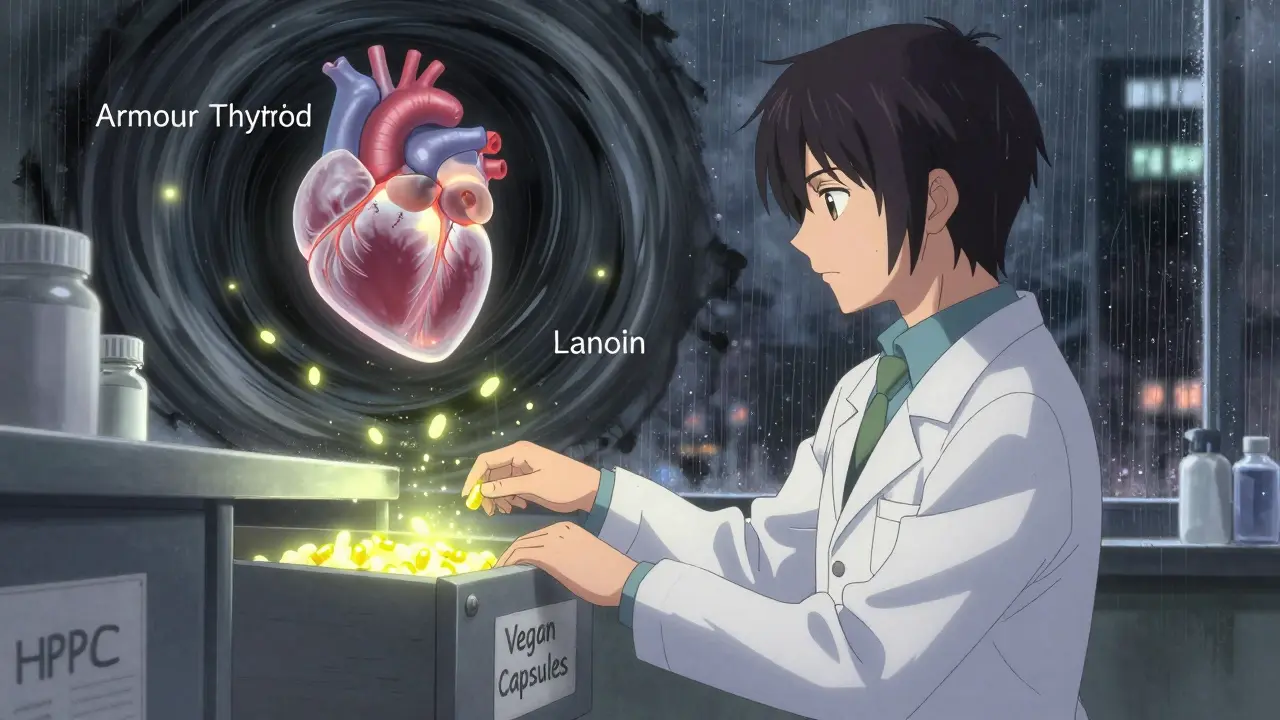
How to Find Vegan-Friendly Medications
You can’t rely on labels. Pharmaceutical labeling laws don’t require disclosure of animal-derived ingredients the way food does. So here’s how to take control:- Ask your pharmacist: ‘Is this medication free from gelatin, magnesium stearate, lanolin, glycerin, and stearic acid?’ Be specific. Don’t just say ‘vegan.’
- Use Pill Clarity (formerly VeganMed). It’s a free online tool that lists verified animal-free medications. It’s updated monthly by pharmacists.
- Check the manufacturer’s website. Some list ingredients in detail. If they don’t, call their customer service.
- For supplements, look for ‘vegan certified’ labels from trusted groups like The Vegan Society or PETA.
- Ask your doctor: ‘Is there a synthetic or plant-based version of this drug?’ Don’t assume they know. Many don’t.
What to Do When There’s No Alternative
Sometimes, there’s no vegan option. Heparin. Armour Thyroid. Propofol. These aren’t choices-they’re necessities. If you’re faced with a medication that conflicts with your ethics, here’s what to do: - Talk to your doctor. Ask if there’s a different treatment path. For example, if you’re on Armour Thyroid, can you switch to levothyroxine? Some people do. - If no alternative exists, consider whether the benefit outweighs the ethical cost. Many vegans choose to take these drugs because health comes first. That’s not hypocrisy-it’s realism. - Support advocacy efforts. The Transparent Label Campaign and Pill Clarity are pushing for mandatory ingredient disclosure. Sign petitions. Write to your MP. Demand change.
Why This Isn’t Just About Diet
This isn’t a lifestyle quirk. It’s a matter of informed consent. People have the right to know what’s in their medicine. If you wouldn’t eat it, why should you swallow it? The vegan population in the U.S. is around 3%-but that’s over 10 million people. In the UK, it’s growing fast. Yet the pharmaceutical industry still treats vegan needs as an afterthought. The same companies that sell plant-based protein powders and vegan cheese won’t change their pill coatings. Why? Because they can get away with it. Labels don’t require it. Pharmacists aren’t trained to ask. Patients don’t know to question it. It’s time that changes.What You Can Do Today
- Check your current supplements. Look up the brand on Pill Clarity. If it’s not listed, call the manufacturer. - Switch your Vitamin D3 to algae-based. It’s cheaper than you think. A month’s supply costs less than a coffee run. - Bring a printed list of animal ingredients to your next doctor’s visit. Include: gelatin, magnesium stearate, lanolin, glycerin, stearic acid, collagen, glucosamine, squalane. - Ask your pharmacy to stock vegan capsules. If enough people ask, they’ll start ordering them. - Talk to friends. Most vegans don’t know this is an issue until they’re told. Share what you’ve learned.Frequently Asked Questions
Are all capsules made from gelatin?
No. Around 90% of capsules are gelatin-based, but many are made from hydroxypropyl methylcellulose (HPMC), a plant-based alternative. These are often labeled as ‘vegetarian capsules’ or ‘vegan capsules.’ Always ask your pharmacist to confirm.
Is levothyroxine vegan?
Yes. Levothyroxine (Synthroid, Tirosint, etc.) is a synthetic form of thyroid hormone and contains no animal products. It’s the standard treatment for hypothyroidism and is widely available in vegan capsules. Armour Thyroid, on the other hand, is made from pig thyroid and is not vegan.
Can I get vegan Vitamin D3?
Yes. Vegan Vitamin D3 is made from lichen or green algae, not sheep’s wool (lanolin). Brands like Deva, Garden of Life, and Viridian offer algae-based D3. Look for ‘vegan-certified’ on the label. It’s just as effective as animal-derived D3.
Why don’t drug labels say if something is animal-derived?
Unlike food, pharmaceuticals aren’t required to disclose the source of inactive ingredients. Gelatin, magnesium stearate, and glycerin are listed by name only-not their origin. This is a regulatory gap, not a technical one. Advocacy groups are pushing for change, but it’s slow.
What if my doctor says there’s no vegan option?
Ask them to check Pill Clarity or contact the manufacturer directly. Sometimes, a different brand or formulation exists that’s vegan. For example, some versions of metformin come in vegan capsules. Don’t accept ‘no’ without verifying. Also, ask if a different class of drug could work-sometimes there’s an alternative treatment entirely.
Is it safe to switch from a non-vegan drug to a vegan one?
For inactive ingredients like gelatin or stearic acid, switching to a vegan version is safe. The active drug remains the same. For active ingredients like thyroid hormone or heparin, you can’t switch unless a different drug is prescribed. Always consult your doctor before changing any medication.
Neil Thorogood
January 26, 2026 AT 03:58So let me get this straight - I’m supposed to swallow pig thyroid and horse pee because my body says so? 🤡 I’m vegan for the animals, not to die of hypothyroidism. If I had a dollar for every time a pill made me feel like a walking ethical dilemma… I’d buy a whole damn lichen farm. 🌱💊 #VeganButNotDead
Jessica Knuteson
January 26, 2026 AT 14:14The pharmaceutical industry operates on a model of informed ignorance. The absence of disclosure is not an accident. It is structural. The moral burden is shifted onto the consumer. This is not a failure of awareness. It is a feature of capitalism.
Angie Thompson
January 28, 2026 AT 05:02OMG I just checked my vitamin D and it’s lanolin 😱 I’m switching to algae-based today!! I didn’t even know this was a thing. My dog’s vegan treats are more transparent than my meds. 🤦♀️✨ Also - if you’re on heparin and feel guilty? You’re not failing. You’re surviving. And that’s enough. 💪❤️
rasna saha
January 30, 2026 AT 02:49This was so eye-opening. I’ve been vegan for 8 years and never thought about my pills. Thank you for sharing this. I’ll ask my pharmacist tomorrow. You’re not alone in this. 🌿
Skye Kooyman
February 1, 2026 AT 01:30Propofol has egg in it? Weird. I wonder if they use the same stuff in vegan mayo
James Nicoll
February 1, 2026 AT 17:08So we’re gonna ban animal products from medicine now? Next they’ll tell us not to breathe oxygen because it’s from plants. 😏 The real vegan crime is pretending we can live without compromise. Wake up.
Uche Okoro
February 3, 2026 AT 16:57The ontological dissonance inherent in the vegan pharmaceutical paradigm is predicated upon an epistemological lacuna in regulatory frameworks. The conflation of inert excipients with bioactive constituents constitutes a category error of pharmaceutical ethics. The hegemony of animal-derived excipients persists due to structural inertia within the pharmacopeia.
bella nash
February 4, 2026 AT 23:52It is imperative to acknowledge that the absence of mandatory disclosure constitutes a de facto violation of the principle of autonomy in medical ethics. The patient’s right to informed consent is not merely procedural - it is foundational.
Ryan W
February 5, 2026 AT 20:24USA makes the best meds. If you’re too soft to swallow pig gelatin, maybe don’t move here. Also, why are you eating plants? They scream too.
Dan Nichols
February 6, 2026 AT 03:22Everyone’s so woke about gelatin but nobody cares that your kale smoothie used 200 gallons of water. Priorities. Also levothyroxine is just synthetic garbage. Real medicine comes from nature.
Renia Pyles
February 7, 2026 AT 20:03Oh wow you’re mad about pig thyroid? I’m mad you think your ethics are more important than my life. You’re not a martyr. You’re just loud.
Rakesh Kakkad
February 8, 2026 AT 06:53Dear sir or madam, I respectfully submit that the ethical implications of pharmaceutical animal-derived components necessitate a structured policy intervention at the national regulatory level. Furthermore, I request a detailed ingredient disclosure protocol to be implemented by the FDA and EMA in alignment with the Universal Declaration of Human Rights, Article 25.