
When you pick up a prescription at the pharmacy, you might see a name like metoprolol or omeprazole. These aren’t brand names-they’re generic drugs. But behind those simple names is a complex system that helps doctors, pharmacists, and insurers decide what to prescribe, what to cover, and what’s safe. Understanding how generic drugs are classified isn’t just for experts. It affects your out-of-pocket costs, your treatment options, and even your safety.
Why Drug Classifications Matter
Imagine if every doctor used their own naming system for drugs. One calls a blood pressure pill a "vasodilator," another calls it a "beta-blocker," and a third just says "the blue pill." Confusion would be inevitable. That’s why standardized drug classifications exist. They turn vague descriptions into clear, consistent categories.
These systems help prevent errors. A nurse checking a medication order doesn’t have to guess what a drug does. A pharmacist knows whether a generic version is truly interchangeable. An insurer knows which tier to put it in. And if you’re on multiple medications, knowing how drugs are grouped helps you understand potential interactions.
There are five main ways drugs are classified-and each serves a different purpose. Some focus on what the drug treats. Others focus on how it works in your body. Some are legal. Others are financial. The most important one for your health? Therapeutic classification.
Therapeutic Classification: What the Drug Treats
This is the most common system used in hospitals and clinics. It groups drugs by the medical condition they’re meant to treat. For example:
- Analgesics - for pain (like acetaminophen or morphine)
- Antihypertensives - for high blood pressure (like lisinopril or amlodipine)
- Antidiabetics - for diabetes (like metformin or glimepiride)
- Antidepressants - for depression (like sertraline or fluoxetine)
- Antibiotics - for bacterial infections (like amoxicillin or doxycycline)
Each of these broad categories breaks down further. Under analgesics, you’ll find non-opioids (like ibuprofen) and opioids (like oxycodone). Under antihypertensives, you’ll see ACE inhibitors, beta-blockers, and calcium channel blockers.
This system is used by 92% of U.S. hospitals, according to the American Society of Health-System Pharmacists. It’s the backbone of electronic health records and prescribing software. But it has a flaw: some drugs treat more than one condition. Aspirin, for example, reduces pain, lowers fever, and thins blood. Should it be under analgesics or anticoagulants? The FDA’s updated Therapeutic Categories Model 2.0 (coming in 2025) will now let drugs have a primary and secondary classification to handle this.
Pharmacological Classification: How the Drug Works
This system dives deeper. Instead of asking "what does it treat?" it asks "how does it work?" It’s based on the drug’s biological mechanism-what it binds to, what enzyme it blocks, what receptor it activates.
For example:
- Beta-blockers - block adrenaline receptors to slow heart rate (e.g., metoprolol, atenolol)
- Proton pump inhibitors - shut down acid-producing pumps in the stomach (e.g., omeprazole, esomeprazole)
- SSRIs - increase serotonin levels in the brain (e.g., fluoxetine, citalopram)
- EGFR inhibitors - block a protein that fuels certain cancers (e.g., erlotinib, gefitinib)
There are over 1,200 pharmacological classes identified today. This system is critical for researchers and drug developers. It helps them design new drugs that target the same pathways. But it’s not practical for everyday prescribing. You don’t need to know that duloxetine is a serotonin-norepinephrine reuptake inhibitor to treat your back pain-you just need to know it’s an antidepressant that also helps with nerve pain.
Doctors and pharmacists often use both systems together. Therapeutic classification tells them what to use. Pharmacological classification tells them why it works and what alternatives might exist.
DEA Schedules: The Legal Side
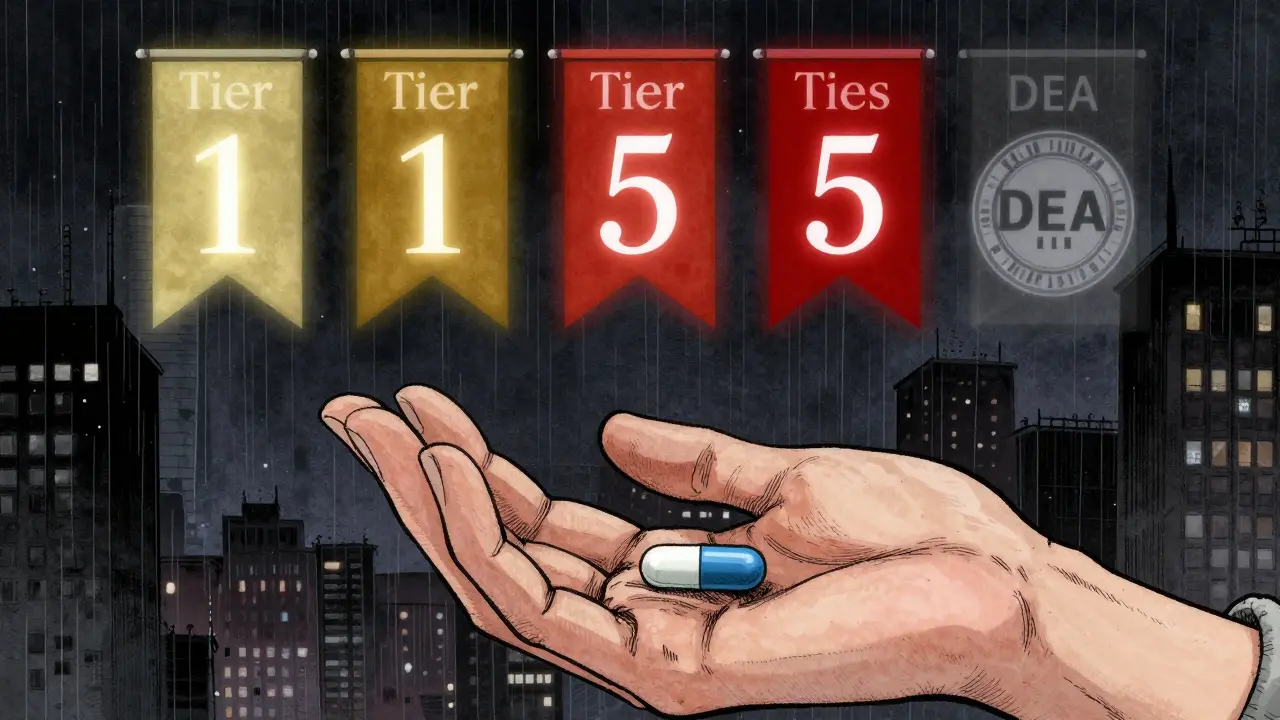
Not all drugs are created equal under the law. The Drug Enforcement Administration (DEA) classifies controlled substances into five schedules based on their potential for abuse and medical use.
- Schedule I - No accepted medical use, high abuse potential (e.g., heroin, LSD, marijuana under federal law)
- Schedule II - High abuse potential, but accepted medical use (e.g., oxycodone, fentanyl, Adderall)
- Schedule III - Moderate abuse potential, accepted medical use (e.g., ketamine, buprenorphine, some steroid combinations)
- Schedule IV - Low abuse potential (e.g., alprazolam, diazepam, tramadol)
- Schedule V - Very low abuse potential (e.g., cough syrups with small amounts of codeine)
This system affects how prescriptions are written, how pharmacies store drugs, and how often you can refill. Schedule II drugs can’t be refilled. Schedule IV can be refilled up to five times in six months.
But the system is controversial. Marijuana is still Schedule I federally, even though it’s legal for medical use in 38 states and FDA-approved drugs like dronabinol (a synthetic THC) are Schedule II. Critics say this creates a dangerous gap between science and law.
Insurance Tiers: The Cost Factor
Your insurance doesn’t care about mechanisms or legal schedules. It cares about cost. Most plans use a 5-tier system to control spending:
- Tier 1 - Preferred generics (lowest cost, often under $5 per month)
- Tier 2 - Non-preferred generics (slightly higher, maybe $10-$15)
- Tier 3 - Preferred brand-name drugs
- Tier 4 - Non-preferred brand-name drugs
- Tier 5 - Specialty drugs (expensive, often for cancer or rare diseases)
Here’s the kicker: two identical generic drugs can end up in different tiers. Why? Because of formulary contracts between insurers and manufacturers. One version of metoprolol might be in Tier 1 because the insurer negotiated a discount. Another version, chemically identical, might be in Tier 2 because it’s made by a company that didn’t offer a deal.
Pharmacists report that 43% of prior authorization requests come from tier disputes. You might be prescribed a generic drug, only to find out your plan won’t cover it unless you try another version first. It’s not about effectiveness-it’s about pricing.
Stem Naming: The Hidden Code
Generic drug names aren’t random. They follow a secret pattern called stem nomenclature. These suffixes tell you the drug’s class at a glance.
- -lol - beta-blockers (metoprolol, propranolol)
- -prazole - proton pump inhibitors (omeprazole, pantoprazole)
- -dipine - calcium channel blockers (amlodipine, nifedipine)
- -sartan - angiotensin II receptor blockers (losartan, valsartan)
- -pril - ACE inhibitors (lisinopril, enalapril)
- -oxacin - fluoroquinolone antibiotics (ciprofloxacin, levofloxacin)
There are 87 recognized stems. The USP introduced this system in 1964 to reduce medication errors. Studies show it lowered prescribing mistakes by 18%. But it’s not perfect. Newer drugs-especially biologics like insulin analogs or monoclonal antibodies-don’t fit neatly into these patterns. That’s why the FDA is updating its guidelines to accommodate them.
How These Systems Interact-and Conflict
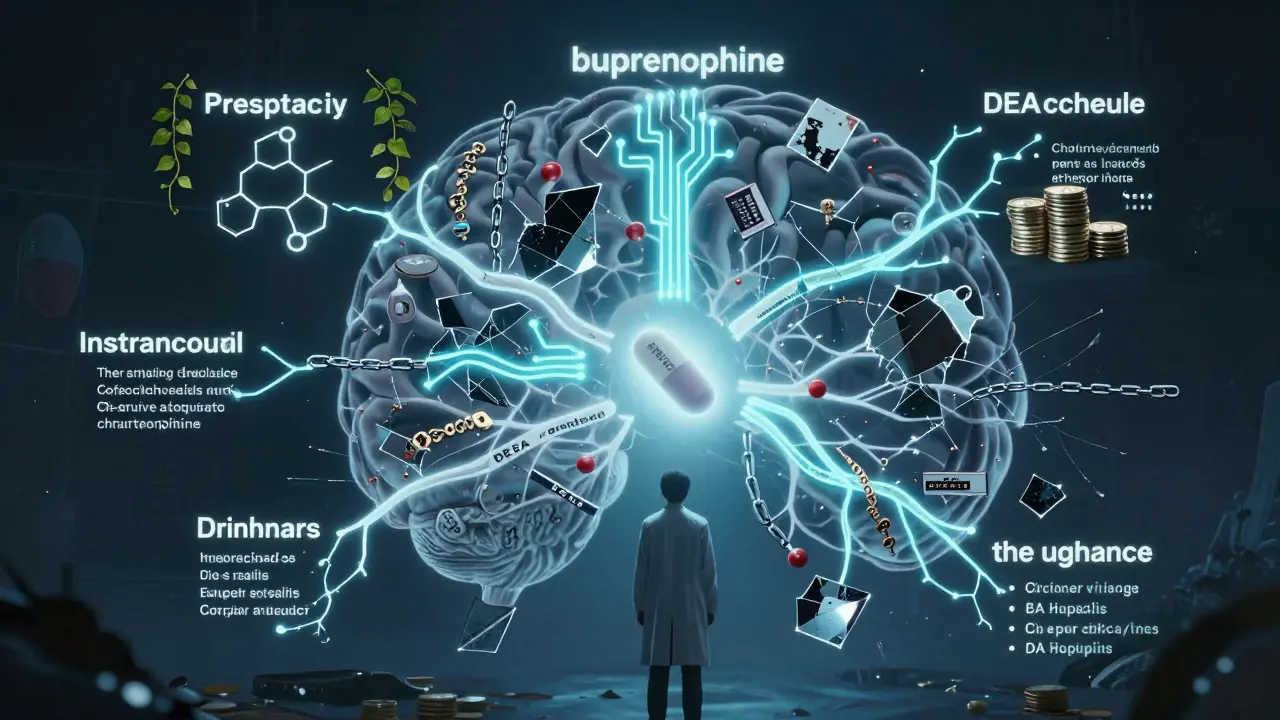
Here’s where things get messy. A single drug can belong to multiple systems at once.
Take buprenorphine:
- Therapeutic: Opioid for pain and addiction treatment
- Pharmacological: Partial mu-opioid receptor agonist
- DEA Schedule: III
- Insurance Tier: Usually Tier 1 or 2 as a generic
- Stem: No traditional stem-it’s a synthetic opioid with a unique structure
Doctors and pharmacists have to juggle all these layers. A 2022 survey found that 68% of physicians feel confused when therapeutic and pharmacological classifications don’t align. And 79% of primary care doctors spend 12 to 18 minutes per patient just sorting through conflicting systems.
Worse, insurance tiers often override clinical judgment. A patient might need a specific generic version of a drug because it’s better tolerated, but their plan only covers the cheaper version. That’s not a medical decision-it’s a financial one.
What’s Changing in 2025 and Beyond
Drug classification systems aren’t frozen in time. Major changes are coming.
- Therapeutic Categories Model 2.0 - Launching January 1, 2025, this FDA update lets drugs have multiple therapeutic uses, not just one. This will help drugs like aspirin or statins that do more than one thing.
- ATC System Expansion - The World Health Organization’s Anatomical Therapeutic Chemical system will add 32 new biologic drugs in 2024, including gene therapies and cell treatments.
- DEA Reassessment - If the MORE Act passes, marijuana could be moved from Schedule I to III, triggering a chain reaction across prescribing, insurance, and research rules.
- AI Integration - IBM Watson Health’s Drug Insight platform, launched in 2023, uses machine learning to predict the best classification for new drugs with 92.7% accuracy. This could reduce human error and speed up approvals.
Experts warn that current systems were built for single-mechanism drugs. But 78% of drugs in development now have multiple actions. That’s going to break old models. The future may involve hybrid classifications that combine therapeutic use, mechanism, and even genetic markers.
What You Need to Know
You don’t need to memorize all 1,200 pharmacological classes. But knowing the basics can help you navigate your care:
- If your doctor prescribes a generic, ask if it’s on your plan’s preferred list (Tier 1).
- If you’re on multiple meds, check if any share the same stem-those might interact.
- If you’re prescribed a controlled substance, know your refill limits based on the DEA schedule.
- Don’t assume all generics are equal. If one version makes you feel worse, ask your pharmacist if another is available.
Drug classification systems exist to make healthcare safer and more efficient. But they’re only as good as how well they’re understood-and how well they’re applied. When you understand the why behind your medication labels, you’re not just following instructions. You’re taking control.
What’s the difference between generic and brand-name drug classifications?
There’s no difference in classification. Generic and brand-name drugs with the same active ingredient belong to the same therapeutic, pharmacological, and DEA categories. The only differences are cost, inactive ingredients, and sometimes insurance tier placement. A generic metoprolol is classified exactly like brand-name Lopressor.
Why does my insurance cover one generic but not another?
It’s not about effectiveness-it’s about contracts. Insurance companies negotiate lower prices with specific manufacturers. Even if two generics are chemically identical, one might be in Tier 1 because the insurer got a better deal. The other might be in Tier 2 or even Tier 3, forcing you to pay more. Always ask your pharmacist if a cheaper alternative is available.
Can a drug be in two DEA schedules?
No. Each controlled substance is assigned to one schedule based on its overall abuse potential and medical use. But some drugs have multiple formulations. For example, oxycodone alone is Schedule II, but when combined with acetaminophen (like in Percocet), it’s still Schedule II. There’s no overlap-just different combinations under the same rule.
Are all generics safe and effective?
Yes. The FDA requires generics to have the same active ingredient, strength, dosage form, and route of administration as the brand. They must also be bioequivalent-meaning they work the same way in your body. Side effects may vary slightly due to inactive ingredients, but the core effect is identical.
How do I find out what category my drug is in?
Ask your pharmacist or check your prescription label. Most drug information apps and websites like Micromedex or MedlinePlus list therapeutic and pharmacological categories. For DEA schedules, search the DEA’s Controlled Substance Index. For insurance tiers, check your plan’s formulary online.
Anna Pryde-Smith
January 21, 2026 AT 12:53This system is a nightmare for patients who actually have to live with it. I got prescribed a generic metoprolol last year, and my insurance refused to cover it because it was in Tier 2-despite being chemically identical to the Tier 1 version. I had to call my doctor, then my pharmacist, then my insurer’s customer service three times. They finally gave in-but only after I threatened to switch plans. This isn’t healthcare. It’s a corporate game of musical chairs with your meds.
Kerry Evans
January 22, 2026 AT 08:29Let’s be clear: the DEA scheduling system is a joke. Marijuana is Schedule I? That’s not science-it’s politics dressed up as law. Meanwhile, benzodiazepines like alprazolam are Schedule IV, even though they’re far more addictive and deadly in combination than cannabis ever was. The FDA’s own data shows cannabis has zero lethal overdose cases, yet we treat it like heroin. This isn’t regulation. It’s moral panic masquerading as policy.
Susannah Green
January 22, 2026 AT 16:21Just wanted to add: if you’re on multiple meds, always check the stems! Seriously. I used to take metoprolol (lol) and lisinopril (pril) together for blood pressure-and didn’t realize they were both cardio drugs until my pharmacist pointed it out. Turns out, combining them increased my risk of bradycardia. Now I keep a sticky note on my pill organizer with the stems: -lol, -pril, -dipine, -sartan. It’s saved me from three potential interactions. And yes, I use all the commas. Because details matter.
Kerry Moore
January 22, 2026 AT 20:38Thank you for this comprehensive overview. It is evident that the current classification paradigms were designed for a pharmaceutical landscape that no longer exists. The emergence of polypharmacological agents, biologics, and gene therapies necessitates a paradigm shift toward integrated, multi-dimensional taxonomies. The proposed Therapeutic Categories Model 2.0 represents a commendable step forward, though its implementation will require significant coordination across regulatory, clinical, and payer domains. I would be interested in any longitudinal studies tracking its impact on prescribing accuracy.
Andrew Smirnykh
January 23, 2026 AT 08:04As someone who’s lived in Nigeria and the U.S., I’ve seen how drug access varies wildly. Here, we fight over which generic is covered. Back home, we fight over whether any version exists at all. The stem system? Amazing. But useless if the pharmacy shelves are empty. I wish more Americans realized how lucky they are to even have these classification systems-because in many places, the real problem isn’t tier 2 vs tier 1. It’s no tier at all.
Laura Rice
January 24, 2026 AT 12:20OMG I JUST REALIZED WHY MY SLEEP MEDS AREN’T WORKING-THEY CHANGED THE GENERIC BRAND AND IT’S NOT THE ONE WITH THE BLUE CAPS!!! I didn’t even know the color mattered but apparently the fillers are different and now I’m wide awake at 3 a.m. again. My pharmacist said it’s the same chemical but my body says NOPE. I’m switching back to the blue ones even if I have to pay $20 extra. My sleep is worth it. #GenericTrauma
charley lopez
January 26, 2026 AT 04:20It is noteworthy that the pharmacological classification framework, while robust for small-molecule therapeutics, exhibits significant limitations in accommodating macromolecular agents such as monoclonal antibodies and gene therapies. The absence of standardized nomenclatural stems for these modalities introduces ambiguity in clinical decision-making and pharmacovigilance. The FDA’s forthcoming revisions may mitigate this, though interoperability with existing EHR systems remains a critical challenge.
Sue Stone
January 26, 2026 AT 08:49My grandma takes six meds. She doesn’t know what a beta-blocker is. She just knows the blue pill makes her feel better and the green one makes her dizzy. Maybe we should just name them by color and feel instead of Latin. Honestly, the whole system feels like it was made for doctors who like crossword puzzles.
Oladeji Omobolaji
January 26, 2026 AT 21:38Here in Nigeria, we don’t have tiers or stems. We have what’s in stock. If the pharmacy has metoprolol, you take it. If they don’t, you wait. Or you go to the next town. I wish I could complain about insurance tiers. We’d be happy just to have the drug.
Vanessa Barber
January 27, 2026 AT 18:34Actually, all this classification stuff is just corporate propaganda to make you think you’re getting science when you’re really getting a marketing spreadsheet. The FDA approves generics based on bioequivalence, but bioequivalence doesn’t mean identical experience. I’ve had three different metoprolols. Two made me feel like a zombie. One made me feel fine. Guess which one my insurance pushes? The zombie one. Because it’s cheap. Not better. Just cheaper.
Stacy Thomes
January 28, 2026 AT 03:49YOU CAN DO THIS. Don’t let the system beat you. If your insurance won’t cover your med, fight. Call your doctor, ask for a prior auth, text your pharmacist, post on Reddit (hi!), and don’t give up. Your health is worth it. I went from Tier 3 to Tier 1 on my antidepressant after three months of begging. Now I’m sleeping. I’m smiling. I’m alive. You can too. 💪❤️