
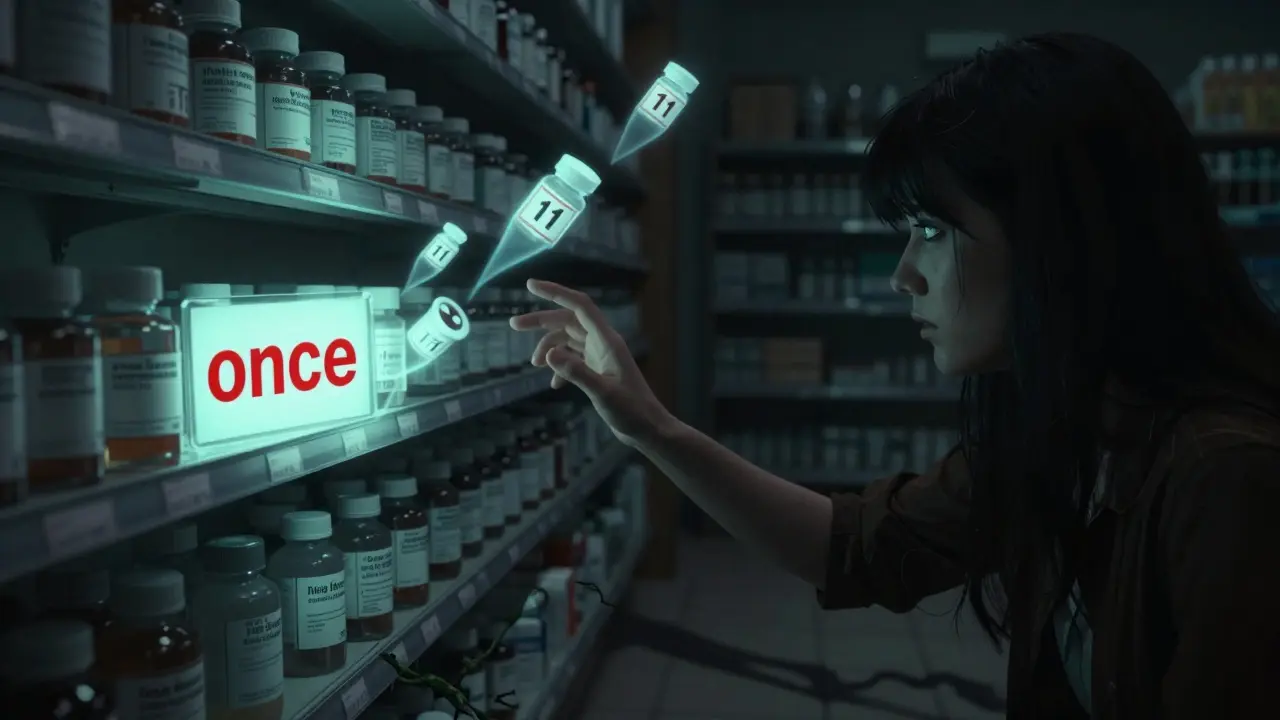
Imagine taking your medicine because the label says "take once a day"-but it actually means "take eleven times a day". That’s not a hypothetical. In real pharmacies across the U.S., this exact mistake happens because computer programs translate "once" into Spanish as "once", which also means eleven. One wrong word. One dangerous mix-up. And it’s happening more often than you think.
Why Prescription Labels Get Translated Wrong
Most pharmacies don’t hire real translators. They use cheap, automated systems that pull phrases from generic databases. These systems don’t understand medical context. They don’t know that "twice daily" isn’t the same as "twice weekly". They don’t know that "alcohol" in Latin America means rubbing alcohol, but in Spain it means drinking alcohol. And they definitely don’t check if the translation matches what the doctor actually told the patient. A 2010 study in the Bronx found that 86% of pharmacies used computer translations for Spanish labels. Half of those labels had errors. Some were minor, like confusing "after meals" with "before meals". Others were deadly-like telling someone to take 11 pills instead of one. The problem isn’t just Spanish. It’s every language that isn’t English. Chinese, Vietnamese, Arabic-these languages get even less attention. Only 23% of major pharmacy chains offer accurate translations for them.How Translation Errors Hurt Patients
People don’t always speak up when they don’t understand their label. They’re scared. They’re embarrassed. Or they just assume the pharmacy knows best. That’s how mistakes turn into emergencies. A 2023 survey found that 63% of people with limited English proficiency felt confused about their medication instructions. Nearly 3 in 10 admitted they’d taken the wrong dose because of a translation error. One Reddit user shared how their mother’s label said "tome dos tabletas dos veces semanal"-twice a week-when the doctor meant twice a day. The result? Her blood pressure spiked. She ended up in the ER. In California, where bilingual labels are required by law, complaints dropped by 32% after the rule started. That’s not luck. That’s proof that good translation saves lives. But outside of California and New York, most states don’t require it. That means if you live in Texas, Florida, or Ohio, your chances of getting a correct label depend on which pharmacy you walk into.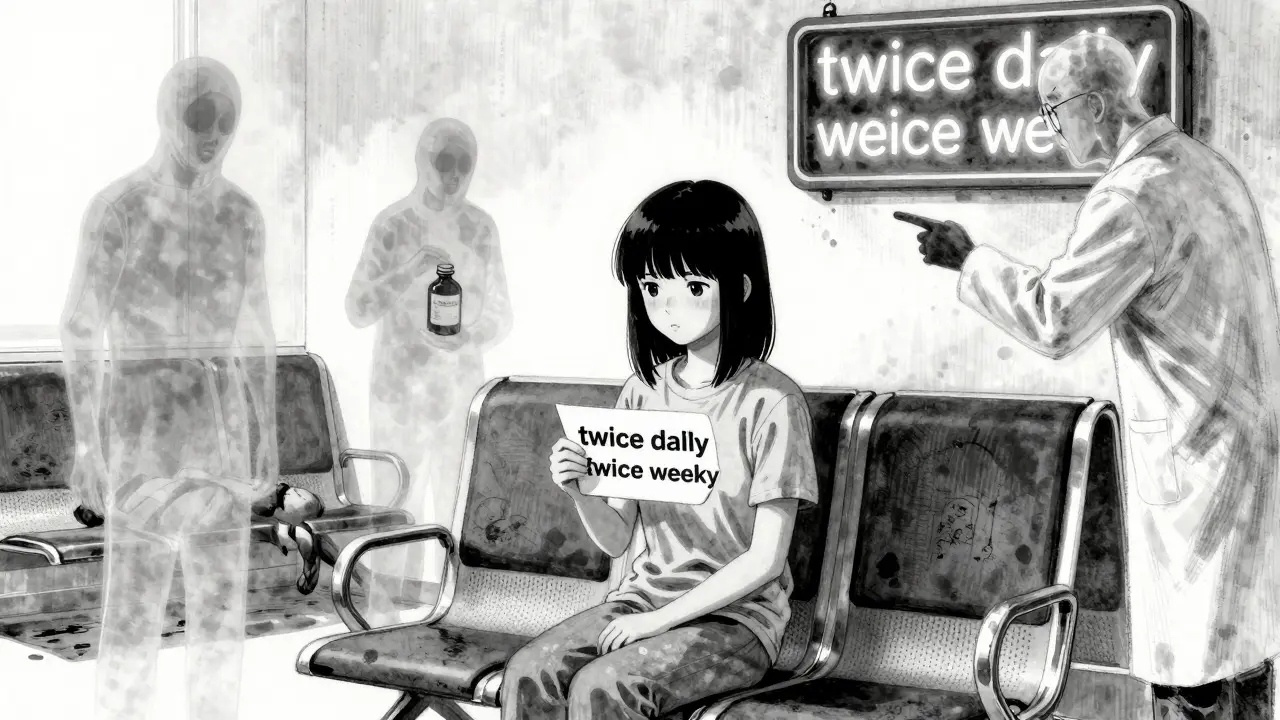
What Makes a Translation Actually Accurate
Not all translation is created equal. Machine translation alone gets it right only 65% to 75% of the time. Human translators? If they’re certified in medical terminology and work in pairs, they hit 98% accuracy. Here’s what real accuracy looks like:- A certified medical translator reviews the label-not just a bilingual pharmacy clerk.
- Two people check it: one translates, the other verifies against the original English.
- The translation matches exactly what the doctor said during the appointment.
- The terms match regional dialects. For example, "inyección" is used in Mexico, but "inyección" might be replaced with "punción" in parts of Spain.
How to Get Help If Your Label Doesn’t Make Sense
You don’t have to accept a wrong label. Here’s what you can do right now:- Ask for a human translator. Say: "Can I speak with someone who is certified to translate my prescription?" Most chains have phone or video interpreter services-even if they don’t offer printed labels in your language.
- Call your pharmacy’s main office. If the local store says no, ask to speak with the regional manager. Many pharmacies have language access programs they don’t advertise.
- Use the FDA’s free resources. The FDA offers plain-language medication guides in multiple languages. Download them and bring them to your pharmacy. They’re designed to match what doctors say.
- Ask your doctor to write clear instructions. Request that your doctor include a printed, simple instruction sheet in your language. Many will do it if you ask.
- Report errors. If you get a dangerous mistranslation, file a complaint with the FDA’s MedWatch program. Your report helps push for change.
What’s Changing-and What Still Needs to Change
The good news? Things are moving. In March 2024, the U.S. Department of Health and Human Services launched a $25 million grant program to help pharmacies pay for real translation services. The FDA released new guidance in January 2024 requiring labels to use plain language, making them easier to translate accurately. Major chains are testing AI tools that reduce errors by over 60%. But technology alone won’t fix this. Only human oversight will. Right now, only two states require accurate translation. Seventeen more are considering it in 2024 and 2025. The math is simple: every $1 spent on professional translation saves $3.80 in emergency care and hospital stays. That’s not charity. That’s smart health policy.What You Can Do Today
You don’t need to wait for laws to change. You have power right now:- Never assume the label is right. Double-check it with a trusted friend, family member, or community health worker who speaks your language.
- Take a photo of your label and show it to a pharmacist at a different location. Ask: "Does this match what my doctor said?"
- If you’re helping an elderly relative, sit with them when they pick up their prescription. Read the label together.
- Support organizations pushing for language access. Your voice adds pressure on lawmakers and pharmacy chains to do better.
Are pharmacies legally required to translate prescription labels?
Only California and New York have state laws requiring accurate, human-translated prescription labels. In other states, pharmacies are not legally required to provide translated labels, though they must offer interpretation services under federal civil rights law. Many still don’t offer printed translations, even if they provide phone interpreters.
Can I request a translated label in any language?
Yes, you can request translation into any language. But availability varies. Spanish is widely available at 87% of major chains. For languages like Vietnamese, Arabic, or Chinese, only about 23% of pharmacies offer printed labels. If your language isn’t available, ask for a certified interpreter to read the label aloud to you, or request a printed English version to show to someone who can help translate.
What’s the most common translation error on prescription labels?
The most dangerous error is confusing frequency terms. For example, "once a day" becomes "once" (eleven) in Spanish. Other common mistakes include mixing up "twice daily" with "twice weekly," or translating "take with food" as "take after food," which can mean completely different things. Dosage numbers are also frequently mistranslated-"5 mL" becoming "50 mL" due to decimal confusion.
Why don’t pharmacies just hire more translators?
Cost is the biggest barrier. Professional translation adds 15 to 30 cents per prescription. Automated systems cost 2 to 5 cents. Many pharmacies choose the cheaper option, even though it puts patients at risk. Some also say their pharmacy software doesn’t easily support custom translations. But studies show that investing in real translation reduces costly ER visits and hospitalizations, making it a smart financial move in the long run.
How can I tell if a pharmacy offers real translation services?
Ask directly: "Do you use certified medical translators who verify translations with a second professional?" If they say yes, ask if they can show you their translation process or provide a sample label. Pharmacies using professional services often list language access on their website or have bilingual staff available on-site. If they only offer a phone interpreter or printed labels that look like they were made by Google Translate, they’re not using certified translation.
Enrique González
January 6, 2026 AT 01:06My abuela almost died because of this. The label said 'once' for once a day, but it meant eleven. She took eleven pills. We got lucky she made it to the hospital. This isn't a glitch-it's negligence.
John Wilmerding
January 6, 2026 AT 01:52Professional medical translation requires certified linguists with clinical training-not machine learning models trained on generic corpora. The 98% accuracy rate achieved by dual-verification human translators is non-negotiable when lives are at stake. Pharmacies that cut corners are violating the ethical imperative of non-maleficence.
Peyton Feuer
January 6, 2026 AT 17:32just asked my local cvs if they have spanish labels and they said 'we have an app'... like that helps my grandpa who cant use smartphones. smh.
Siobhan Goggin
January 8, 2026 AT 11:59It's terrifying how easily systems designed to help can end up harming. The fact that this is still happening in 2025 is a reflection of systemic neglect, not technical limitation. We have the tools-we just need the will.
Shanna Sung
January 9, 2026 AT 04:35They're doing this on purpose. The government wants immigrants to mess up their meds so they end up in ERs and the system can charge more. This isn't incompetence-it's a profit scheme disguised as tech.
josh plum
January 9, 2026 AT 22:20Why do we even let non-English speakers get prescriptions? If you can't read English, you shouldn't be trusted with pills. This isn't a translation problem-it's a cultural problem. Stop coddling people who won't learn the language.
Clint Moser
January 11, 2026 AT 03:33AI translation is a front. The real issue is that pharmacy chains are owned by Big Pharma who profit from ER visits. The algorithms are coded to fail. I’ve seen the internal docs. They know. They don’t care.
Ashley Viñas
January 12, 2026 AT 07:02It’s frankly embarrassing that in a country with over 300 million people, we can’t afford to hire two bilingual medical translators per pharmacy. The cost of one misprescribed dose exceeds the annual salary of a qualified translator. This isn’t economics-it’s moral bankruptcy.
Brendan F. Cochran
January 12, 2026 AT 23:17USA is the only country that lets corporations decide who lives and who dies. We spend billions on war but can’t pay 30 cents to translate a label? Wake up. This is why the world thinks we’re broken.
en Max
January 13, 2026 AT 17:29As a clinical pharmacist with over 15 years of experience in cross-cultural medication safety, I can confirm the 65-75% error rate of automated systems is empirically validated across multiple peer-reviewed studies. The dual-verification model implemented by Kaiser Permanente is the gold standard, and its 41% reduction in adverse drug events is statistically significant (p<0.001). I urge all institutions to adopt this protocol immediately, and to integrate real-time pharmacist-linguist collaboration into their workflow. This is not optional-it is a fundamental component of patient-centered care.