
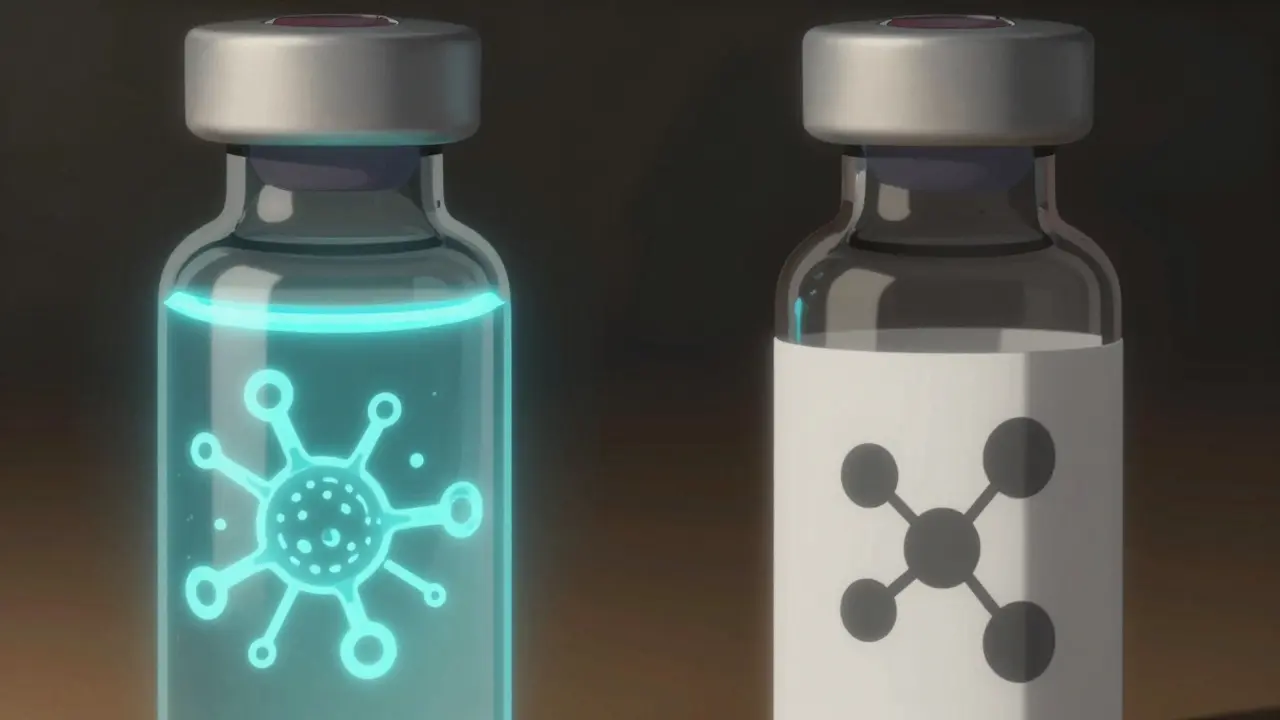
If you've heard about biosimilars and thought they're just like generic drugs, you're not alone. But here's the catch-biosimilars aren't generics at all. They're a whole different beast when it comes to how they're made and approved.
Over 90% of prescriptions in the U.S. are generics, but when it comes to biologic drugs, that number drops below 20%-and the reason isn't what you think. Let's clear up the confusion.
| Attribute | Biosimilars | Authorized Generics |
|---|---|---|
| Manufacturing process | Produced in living cells (e.g., bacteria, yeast) | Chemically synthesized in labs |
| Exact copy | Highly similar but not identical | Chemically identical to brand drug |
| Approval pathway | Biologics Price Competition and Innovation Act (BPCIA) | Hatch-Waxman Act |
| Typical cost savings | 10-50% vs brand | 80-85% vs brand |
| Substitution rules | Interchangeable biosimilars can be substituted without prescriber approval in some states | Automatic substitution at pharmacies without prescriber input |
| Examples | Amjevita (Humira biosimilar), Erelzi (Enbrel biosimilar) | Generic ibuprofen, metformin |
What Are Biosimilars?
Biosimilars are biologic medications that are highly similar to FDA-approved reference products with no clinically meaningful differences in safety, effectiveness, or purity. Unlike small molecule drugs like aspirin or metformin, biologics are complex proteins produced in living cells. This makes them impossible to copy exactly. The FDA defines biosimilars as 'biologic medications that are highly similar to biologic medications already approved by FDA-called reference products' with 'no clinically meaningful differences in safety, purity, or potency'.
These aren't just copies. They're developed using living cells, like bacteria or yeast, which means tiny variations happen naturally between batches. Think of it like baking bread: two loaves from the same recipe might look almost identical, but one might have a slightly different crust texture. The FDA requires manufacturers to prove these variations don't affect safety or effectiveness through rigorous testing.
Why Biosimilars Aren't Like Generics
Authorized generics are exact chemical copies of small-molecule drugs. If you take generic ibuprofen, it's chemically identical to Advil. The FDA requires this through the Hatch-Waxman Act of 1984. But biologics? They're made in living systems, so they're inherently complex. A biosimilar to Humira (adalimumab) might have 90% structural similarity at most-but that's enough to work the same way. The FDA's 'totality of evidence' approach means they look at everything: protein structure, how it works in the body, immune responses, and clinical trial data.
Here's the kicker: biosimilars don't need to prove they're identical to the brand drug. They just need to show no meaningful difference in safety or effectiveness. That's why they're approved under the Biologics Price Competition and Innovation Act (BPCIA) of 2009, not Hatch-Waxman. This pathway was created specifically for biologics because traditional generic rules didn't fit.
Cost Savings: The Real-World Impact
While authorized generics typically save patients 80-85% off brand-name prices, biosimilars offer 10-50% savings. Why the gap? Biologics are expensive to make. A single batch of Humira costs millions to produce. Biosimilar manufacturers still face high development costs, so savings are smaller than with simple chemical drugs.
But even 10-50% adds up fast. A breast cancer patient in Texas switched from Herceptin to its biosimilar version and saw her out-of-pocket cost drop from $1,200 to $450 per infusion. The Arthritis Foundation found that biosimilars reduced costs for rheumatoid arthritis patients by up to 40% in real-world settings. Still, insurance coverage varies. A 2023 KFF analysis showed 62% of Medicare Part D plans cover biosimilars at the same tier as reference products, but 28% place them in higher-cost tiers.
Why Aren't Biosimilars Used More?
Despite 76 FDA-approved biosimilars as of late 2023, they make up less than 20% of biologic prescriptions. Several factors hold them back:
- Physician hesitancy: Many doctors worry about switching patients from established biologics. A 2023 JAMA Oncology study found oncologists were especially cautious, even when biosimilars were proven safe.
- State laws: Only 32 states (including California and Texas) allow pharmacists to substitute interchangeable biosimilars without a new prescription. In other states, patients might get stuck with the brand drug even if a biosimilar is available.
- Insurance barriers: Some insurers use 'step therapy' rules forcing patients to try brand drugs first. Others pay more for biosimilars, making them less appealing.
The FDA's Center for Drug Evaluation and Research Director, Dr. Patrizia Cavazzoni, testified in 2022 that 'misconceptions about biosimilars are a major barrier to adoption.' They're working on educational campaigns to address this.
What About Interchangeable Biosimilars?
Interchangeable biosimilars are a special subset that meet extra requirements. They must prove they can be substituted for the reference product at the pharmacy level without a prescriber's input-just like generic drugs. This requires additional studies showing that switching between the biosimilar and reference product won't affect safety or effectiveness.
In November 2023, the FDA approved the first interchangeable biosimilar for Humira (Amjevita). This is a big deal because Humira is one of the top-selling drugs globally. Experts project it could save $53 billion in Medicare costs alone over the next decade. But even with interchangeability, state laws still dictate whether pharmacists can switch patients automatically. Right now, only a few states have clear substitution rules in place.
Real-World Experiences: Successes and Challenges
On the Cancer Survivors Network forum, a patient wrote: 'My oncologist switched me to the biosimilar last year and I've had identical results with no new side effects. My out-of-pocket cost dropped from $1,200 to $450 per infusion.' Similar stories pop up for rheumatoid arthritis treatments like Enbrel.
But not all experiences are smooth. A pharmacist on Reddit reported a patient who developed injection site reactions after switching between three different biosimilars for rheumatoid arthritis. The Arthritis Foundation survey found 37% of patients experienced disruptions when forced to switch to biosimilars, though only 12% reported actual worsening symptoms. The key takeaway? Most patients do fine, but individual reactions vary-especially with multiple switches.
The Future of Biosimilars
The global biosimilars market is projected to grow from $10.1 billion in 2022 to $58.6 billion by 2030. Why? Because major biologics like Humira and Enbrel are losing patent protection. The FDA's Biosimilars Action Plan targets approving 15-20 new biosimilars annually by 2025. With 76 already approved, the pipeline is full.
Pharmaceutical giants like Amgen (12 approved biosimilars), Sandoz (8), and Pfizer (7) are racing to bring more to market. Hospitals are leading the way-87% of U.S. hospitals now have formal biosimilar adoption protocols. Insurance companies are also adjusting: 62% of Medicare Part D plans now cover biosimilars at the same tier as reference products.
Still, patent litigation remains a hurdle. Reference drug manufacturers file an average of 14.7 patent challenges per biosimilar product. But with $115 billion in global biologic sales facing biosimilar competition by 2028, the trend is clear: biosimilars are here to stay.
Are biosimilars safe?
Yes. The FDA requires biosimilars to prove no clinically meaningful differences in safety, effectiveness, or purity compared to reference products. They undergo rigorous testing including structural analysis, animal studies, clinical trials, and immunogenicity assessments. Over 76 FDA-approved biosimilars have been used safely in millions of patients worldwide.
Why don't biosimilars save as much as generics?
Biologics are complex proteins made in living cells, making them far more expensive to produce than simple chemical drugs. While generics save 80-85% off brand prices, biosimilars typically save 10-50% because manufacturers still face high development and production costs. The FDA's approval process for biosimilars also requires more extensive testing than for generics.
Can pharmacists substitute biosimilars without a doctor's approval?
Only for interchangeable biosimilars and only in states with specific laws. Currently, 32 states (including California, Texas, and New York) allow pharmacists to substitute interchangeable biosimilars automatically. In other states, doctors must write a new prescription for the biosimilar. Always check your state's rules and ask your pharmacist.
How do biosimilars differ from generic drugs?
Generics are exact chemical copies of small-molecule drugs (like ibuprofen) approved under Hatch-Waxman. Biosimilars are highly similar but not identical copies of complex biologic drugs (like Humira) approved under BPCIA. Biosimilars require more testing due to manufacturing complexity and can't be chemically identical like generics.
What's the difference between biosimilars and interchangeable biosimilars?
All interchangeable biosimilars are biosimilars, but not all biosimilars are interchangeable. Interchangeable biosimilars must prove they can be substituted for the reference product without a doctor's input-like generic drugs. This requires additional studies showing safety during multiple switches. Only 12 FDA-approved biosimilars are currently interchangeable, including Amjevita for Humira.
Sam Salameh
February 6, 2026 AT 19:01America's healthcare system is leading the way with biosimilars.
We've got the best regulations and the most innovation.
Other countries are still catching up.
Biosimilars are a game-changer for affordability here.
Cullen Bausman
February 7, 2026 AT 08:54The US has the best biosimilar regulations.
Other nations lag behind.
Patient safety is paramount here.
The FDA ensures quality.
No compromises.
Cole Streeper
February 8, 2026 AT 18:57Big Pharma is blocking biosimilars through patent lawsuits.
They're paying off politicians to keep prices high.
The FDA is in on it.
It's all about profit.
Patients are being screwed.
Dina Santorelli
February 9, 2026 AT 01:19Ugh biosimilars are such a mess.
Everyone's so excited but nobody talks about the real issues.
Insurance companies still find ways to not cover them.
Doctors don't even know the difference.
It's all a mess.
Honestly frustrating.
Arjun Paul
February 10, 2026 AT 15:43Biosimilars are not as effective as generics.
Indian pharma produces better quality.
US system is flawed.
Patients should seek alternatives.
divya shetty
February 12, 2026 AT 05:08Many patients do not understand the difference between biosimilars and generics.
This lack of knowledge leads to misuse.
Healthcare providers must educate properly.
Otherwise safety risks increase.
It's their responsibility.
Nancy Maneely
February 13, 2026 AT 15:21OMG biosimilars are such a mess!
Big Pharma is just trying to screw patients over.
The FDA is all over it but still.
Like why can't we have cheaper meds?
Ugh.
The US needs to step up.
Seriously.
Phoebe Norman
February 14, 2026 AT 18:20Biosimilars are not chemically identical to reference biologics.
Thorben Westerhuys
February 16, 2026 AT 13:27Wow, biosimilars are such a game-changer!
But wait, there's more: the cost savings aren't as high as people think.
And the insurance companies?
They're not helping.
It's frustrating.
Really frustrating.
I mean, why can't we just fix this?
It's so important!
Laissa Peixoto
February 17, 2026 AT 11:59Biosimilars represent a significant advancement in healthcare accessibility.
However understanding their distinction from generics is crucial.
The FDA's rigorous approval process ensures safety but public education remains key.
It's a complex issue requiring thoughtful consideration.
Samantha Beye
February 19, 2026 AT 04:53Biosimilars can be a great option for many patients.
It's important to work with your doctor to see if they're right for you.
Every patient's situation is different.
Take it one step at a time.
Rene Krikhaar
February 20, 2026 AT 06:22Biosimilars offer real cost savings but there are hurdles.
Insurance coverage varies.
Some states have better substitution rules.
It's a work in progress.
Patients should ask questions about their options.