
Imagine waking up and feeling like there is sand in your eyes, only to look in the mirror and see that your eyes appear to be bulging or that you have a permanent expression of surprise. For many, this isn't just a bad morning-it's the reality of Autoimmune Thyroid Eye Disease is an autoimmune condition where the immune system attacks tissues around the eyes, causing inflammation and swelling of orbital fat, connective tissues, and muscles. Also known as Graves' orbitopathy or Thyroid-associated orbitopathy, this condition transforms the physical appearance of the eyes and can seriously threaten vision if left unchecked. While it's most often tied to Graves' disease, the impact goes far beyond a simple thyroid imbalance, affecting how people see, drive, and feel about themselves.
The Connection Between Your Thyroid and Your Eyes
Why do thyroid issues affect the eyes? It comes down to a case of mistaken identity. In people with Graves' disease is an autoimmune disorder that causes hyperthyroidism by overstimulating the thyroid gland ], the body produces anti-thyroid-stimulating hormone receptor (anti-TSHR) antibodies. These antibodies don't just target the thyroid; they also bind to TSH receptors located in the tissues of the eye socket. This triggers a cascade of inflammation and tissue remodeling, causing the muscles and fat behind the eye to swell, which literally pushes the eyeball forward.
It's a bit of a gamble who develops these symptoms. About one in three people with Graves' disease will experience eye issues, usually within the first six months of diagnosis. Interestingly, the disease typically moves in two waves: an active inflammatory phase that lasts one to three years, followed by an inactive phase where the swelling stops, but the structural damage remains.
Recognizing the Warning Signs
TED doesn't always start with a dramatic change. It often begins with subtle irritations. About 78% of patients report a constant grittiness, and up to 80% deal with eyes that are either too dry or excessively watery. But as the inflammation progresses, the symptoms become more concrete and visible.
The most telltale signs include:
- Proptosis: This is the medical term for bulging eyes. It happens because the orbital fat and muscles are expanding, leaving no room for the eye to stay in its normal position.
- Eyelid Retraction: The upper eyelid pulls back, creating a "staring" or startled look.
- Diplopia: Double vision occurs in roughly 50% of moderate to severe cases because the swollen muscles prevent the eyes from moving in sync.
- Photophobia: About 60% of patients find light painfully bright.
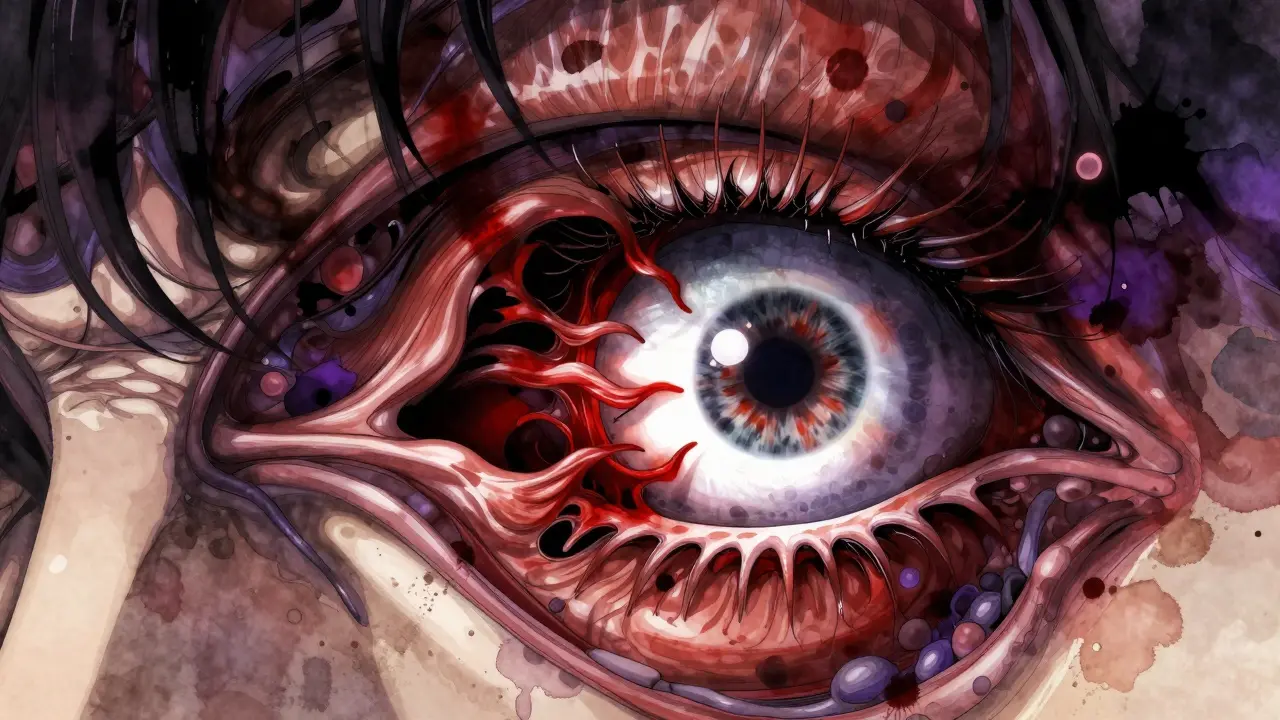
In rare but severe cases (around 5%), the swelling can actually compress the optic nerve. This is a medical emergency. A key red flag here is the loss of color vision, which appears in 85% of these compressive cases. If you notice your colors looking faded or your vision blurring rapidly, you need an immediate specialist evaluation.
How Doctors Diagnose and Track TED
Getting a correct diagnosis can be surprisingly slow. Many people are initially told they just have "allergies" or "sinus problems." To get a clear picture, doctors use a mix of blood work and high-tech imaging. They check TSH, free T4, and free T3 levels, but the anti-TSHR antibody count is the real clue, as it correlates with severity in 75% of cases.
To see what's actually happening inside the socket, specialists use Optical Coherence Tomography is a non-invasive imaging test that uses light waves to take cross-section pictures of the retina and optic nerve ] and orbital CT or MRI scans. These scans reveal which muscles are enlarged; the medial rectus (the muscle that moves the eye inward) is affected in 90% of cases.
One of the most important tools for determining treatment is the Clinical Activity Score (CAS). This isn't a blood test, but a clinical assessment of pain, redness, and swelling. If your score is 3 or higher, the disease is considered "active," meaning anti-inflammatory treatments are likely to work. If the score is low but you still have bulging eyes, you've likely moved into the inactive phase, where surgery becomes the primary option.
| Treatment | Best Phase | Primary Goal | Typical Success/Response |
|---|---|---|---|
| Selenium Supplements | Mild Active | Slow progression | 35% reduction in severity |
| Corticosteroids (IV) | Moderate/Severe Active | Reduce inflammation | 60-70% response rate |
| Tepezza (Teprotumumab) | Moderate/Severe Active | Reduce proptosis/diplopia | 71% reduction in bulging |
| Orbital Decompression | Any (if vision is threatened) | Save the optic nerve | High emergency efficacy |
| Strabismus Surgery | Inactive | Correct double vision | 75-85% success rate |
Modern Treatment Progress: The Tepezza Revolution
For decades, the only real option for active TED was high-dose steroids. While they work, they come with a heavy price: glucose intolerance in up to 30% of patients and potential liver toxicity. Everything changed in January 2020 with the FDA approval of Tepezza is a monoclonal antibody known as teprotumumab that inhibits the insulin-like growth factor-1 receptor (IGF-1R) to reduce inflammation and eye bulging ].
Unlike steroids, which just dampen the overall immune response, Tepezza targets the specific receptor that causes the tissues to swell. In phase 3 trials, it showed a 71% reduction in proptosis compared to just 20% for the placebo. For many, this has been a life-changer, allowing them to regain the ability to drive at night or stop the emotional distress of their changing appearance. However, it's not without risks; about 12% of users report hearing impairment, and the cost can be staggering, often totaling around $44,000 for a full course of eight infusions.
When Surgery Is the Only Answer
Treatment is all about timing. If you are in the active inflammatory phase, you want drugs. But if the inflammation has settled and you're left with permanent double vision or a drooping lid, drugs won't help. That's when you move to corrective surgery.
There are three main types of surgical intervention:
- Orbital Decompression: This is used in the most critical cases. Surgeons remove a small amount of bone or fat from the eye socket to create more room, relieving pressure on the optic nerve. Today, 65% of these are done endoscopically to avoid large external scars.
- Strabismus Surgery: This focuses on the muscles. By adjusting the tension of the extraocular muscles, surgeons can align the eyes and eliminate double vision in 30-40% of patients.
- Eyelid Surgery: This addresses the "startled" look or the inability to close the eyes fully, protecting the cornea from ulcers.
Lifestyle Factors and Managing the Journey
Beyond medication and surgery, there is one factor that outweighs almost everything else: smoking. Research shows that smoking increases the risk of developing TED by 7.7-fold and makes the disease much more likely to be severe. Quitting is the single most effective way to improve your prognosis.
Because this disease hits both your endocrine system and your vision, a team approach is non-negotiable. You need an endocrinologist to manage your thyroid levels and an oculoplastic surgeon to manage the eye socket. The best outcomes happen when these two specialists work in a coordinated clinic, which can reduce the time to treatment by about 45 days.
Can Thyroid Eye Disease be cured completely?
While there isn't a one-time "cure" that prevents the disease from ever occurring, it can be managed into remission. Treatments like Tepezza can significantly reduce bulging and inflammation, and surgeries can fix the structural damage left behind after the active phase. The goal is functional recovery and cosmetic improvement.
Is Tepezza safe for everyone?
Tepezza is highly effective but has specific side effects. The most notable are muscle cramps and a risk of hearing impairment (reported in about 5.7% of post-marketing cases). It is generally reserved for moderate to severe active TED. Patients should have their hearing monitored during treatment.
Why do I have double vision with TED?
Double vision, or diplopia, happens because the muscles that move your eyes become inflamed and stiff. When one muscle is tighter or larger than the other, your eyes no longer point in the same direction, causing your brain to see two separate images.
What is the 'active phase' of TED?
The active phase is the period (usually 1-3 years) where the immune system is actively attacking the orbital tissues. This is characterized by redness, pain, and swelling. This is the only time when anti-inflammatory drugs like steroids or Tepezza are truly effective.
Can TED cause permanent blindness?
Yes, though it is rare (about 5% of cases). This happens via Compressive Optic Neuropathy, where the swelling is so severe it squeezes the optic nerve. This is a medical emergency that requires immediate orbital decompression surgery to save the vision.