
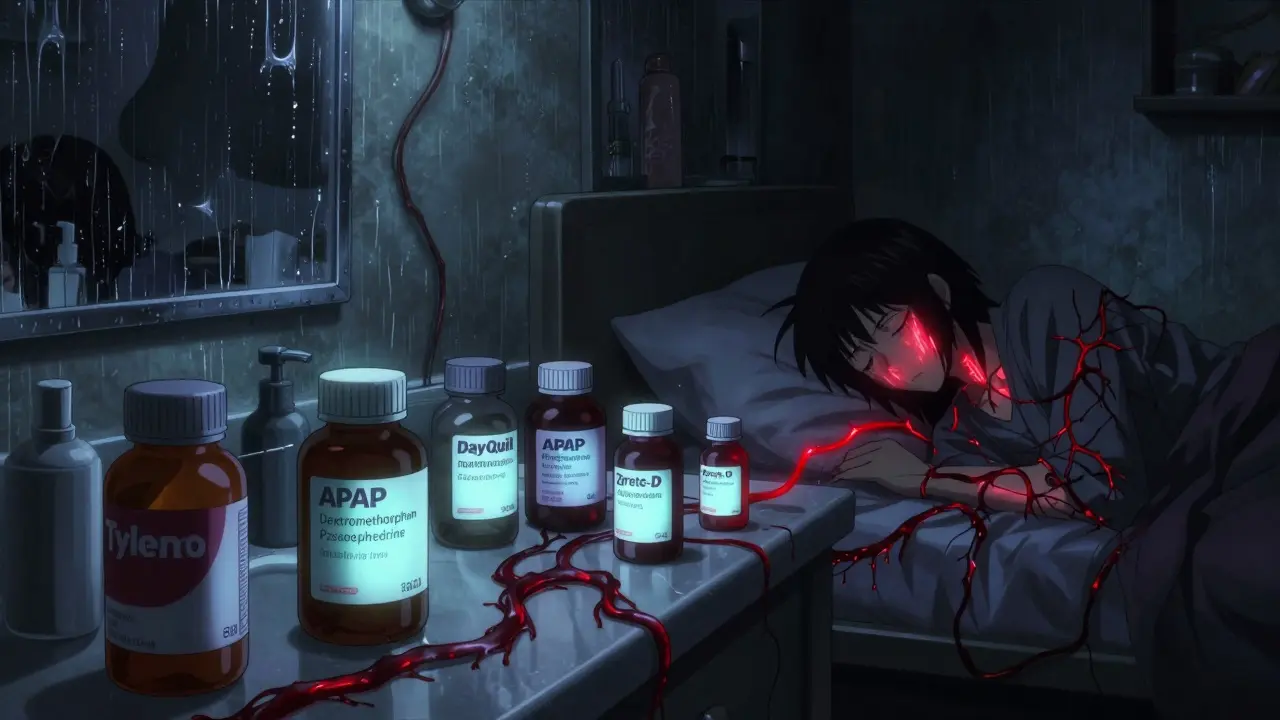
Every winter, millions of people reach for combination cold and allergy medications because they promise quick, all-in-one relief. You’ve probably done it too-grabbed a bottle labeled "Multi-Symptom Cold & Allergy" and assumed it was safe. But here’s the truth: combination cold and allergy medications are one of the most common causes of accidental drug overdoses in the U.S., and many people have no idea why.
These pills and liquids often contain three or four active ingredients: something for your runny nose (an antihistamine), something to unclog your sinuses (a decongestant), something for your fever or headache (an analgesic), and something to quiet your cough (a cough suppressant). Sounds convenient, right? But mixing these ingredients without knowing what’s inside can turn a simple cold into a medical emergency.
What’s Really in Your Medicine Bottle?
Let’s break down what you’re likely swallowing. Most combination cold and allergy products include one or more of these ingredients:
- Acetaminophen (APAP) - For pain and fever. Found in Tylenol, DayQuil, NyQuil, and many store brands.
- Pseudoephedrine - A strong decongestant. Found in Sudafed. Requires pharmacy purchase in the U.S. due to abuse potential.
- Phenylephrine - A weaker decongestant. Found in Sudafed PE, Tylenol Sinus, and most OTC products. Recent studies suggest it doesn’t work well at standard doses.
- Dextromethorphan (DM) - A cough suppressant. Found in Robitussin DM, Delsym, and many multi-symptom formulas.
- Chlorpheniramine or Diphenhydramine - Antihistamines that cause drowsiness. Found in Zyrtec-D, Benadryl Cold, and similar products.
Here’s the problem: you might be taking acetaminophen for your headache, then grab a cold medicine that also has acetaminophen-and you don’t realize it. The same goes for dextromethorphan. If you’re on an antidepressant like sertraline or fluoxetine, combining it with dextromethorphan can trigger serotonin syndrome-a rare but life-threatening condition that causes high fever, confusion, rapid heartbeat, and seizures.
The Hidden Danger: Double-Dosing on Acetaminophen
Acetaminophen is the most common cause of acute liver failure in the U.S. Each year, about 6.7 million Americans accidentally take too much of it, according to CDC data. Why? Because it’s hidden.
Look at any bottle of DayQuil, NyQuil, or Coricidin HBP. You’ll see "acetaminophen" listed, but you might not notice it if you’re focused on the "cold and flu" label. Worse, some labels use "APAP"-a shorthand for acetaminophen that 68% of consumers don’t recognize. So if you take Tylenol for your fever and then take NyQuil for your cough, you’re doubling up without knowing it.
The FDA limits acetaminophen to 4,000 milligrams per day. But one dose of NyQuil can contain 650 mg. Two doses? That’s 1,300 mg. Add a regular Tylenol tablet (500 mg), and you’re already over a third of your daily limit. Do that three times in a day? You’re at risk of liver damage. And once liver damage starts, it’s often silent-no pain, no warning signs-until it’s too late.
Decongestants and Your Heart
Decongestants like pseudoephedrine and phenylephrine work by tightening blood vessels. That’s why they clear your nose. But they also tighten blood vessels everywhere-including around your heart and brain.
Research published in the Journal of Clinical Pharmacology in 2014 showed that when phenylephrine (5 mg) is combined with acetaminophen (500 mg), the blood levels of phenylephrine spike to four times higher than when taken alone. This isn’t just theoretical. New Zealand data found phenylephrine-acetaminophen combos cause 4.1 times more hypertension-related side effects than acetaminophen alone.
Pseudoephedrine is more effective-it reduces nasal congestion by 65% compared to phenylephrine’s 45%. But it also raises blood pressure by 8-12 mmHg and heart rate by 5-8 beats per minute on average. If you have high blood pressure, heart disease, or an irregular heartbeat, these medications can be dangerous. The FDA recommends avoiding them if your systolic pressure is over 180 mmHg or diastolic over 110 mmHg.

When Cough Medicine Turns Dangerous
Dextromethorphan (DM) is the most common cough suppressant in OTC cold medicines. It’s generally safe when used alone. But when mixed with certain antidepressants-especially SSRIs like Prozac, Zoloft, or SNRIs like Cymbalta-it can cause serotonin syndrome.
A 2017 study in the Journal of Clinical Psychiatry found that combining dextromethorphan with SSRIs increases the risk of serotonin syndrome by 300%. Symptoms include agitation, confusion, muscle rigidity, fast heartbeat, high temperature, and even seizures. Emergency rooms see dozens of these cases every year, especially in people who don’t realize their cold medicine contains DM.
And it’s not just antidepressants. Dextromethorphan should also be avoided with MAO inhibitors (used for depression or Parkinson’s) and certain migraine medications. The 14-day waiting period after stopping an MAOI isn’t a suggestion-it’s a safety rule backed by real deaths.
What You Should Do Instead
Here’s the hard truth: combination medications aren’t better-they’re riskier. If you have a runny nose and a cough, you don’t need a pill that also contains acetaminophen and a decongestant. You might only need one thing.
Instead of grabbing a multi-symptom product, try this:
- Identify your main symptom. Is it congestion? A cough? A fever? Pick the medicine that treats just that.
- Read the Drug Facts label. Look for active ingredients-not brand names. Write them down if you have to.
- Check for duplicates. If you’re already taking Tylenol, don’t take NyQuil. If you’re on Zoloft, avoid DayQuil DM.
- Use a drug checker. Apps like Medisafe or WebMD’s Drug Interaction Checker scan barcodes and flag conflicts. Over 1.2 million checks are done daily.
- Ask your pharmacist. Pharmacists aren’t just there to hand you pills. They’re trained to catch these mistakes. Take 15 minutes to talk to them.
Who’s at Highest Risk?
You might think this only happens to older people or people on lots of prescriptions. But the data says otherwise.
A Consumer Reports survey found that 41% of adults don’t check all ingredients before buying cold medicine. The biggest offenders? People between 25 and 45-those juggling work, kids, and a busy life. They’re not careless; they’re overwhelmed. And the labels aren’t helping. Many still use tiny print, confusing abbreviations, and vague warnings.
People with chronic conditions are especially vulnerable:
- Those with high blood pressure or heart disease
- People taking antidepressants, anxiety meds, or Parkinson’s drugs
- Those with liver disease or who drink alcohol regularly
- Older adults taking multiple medications
If you fall into any of these groups, you should avoid combination products entirely. Stick to single-ingredient options-and always talk to your doctor before taking anything new.
What’s Changing in 2026?
The FDA is finally stepping in. In March 2023, they announced new labeling rules that take effect by December 2024. All combination cold and allergy products must now use:
- High-contrast, bold text for active ingredients
- Clear warnings like "Contains acetaminophen-do not take with other acetaminophen products"
- Standardized abbreviations (no more "APAP" without explanation)
And there’s more. In September 2023, the FDA’s advisory committee reviewed evidence that oral phenylephrine-at the 10 mg dose found in most products-doesn’t work any better than a placebo. If they decide to remove it from the market, 30% of current cold medicines could be reformulated or pulled. That means you’ll soon see fewer "Sudafed PE" products and more reliance on pseudoephedrine (which requires ID and pharmacy purchase).
Manufacturers are already testing alternatives. McNeil, the maker of Tylenol, has filed patents for new formulas using caffeine and guaifenesin instead of phenylephrine. Whether those will be safer or just different remains to be seen.
The Bottom Line
Combination cold and allergy medications aren’t evil. They’re convenient. But convenience comes at a cost-and that cost is your health.
Before you reach for that bottle, ask yourself: Do I really need all of this? Or am I just taking extra drugs because they’re in the same pill? You don’t need to treat every symptom at once. Sometimes, less is more.
If you’re unsure, skip the combo. Get a single-ingredient medicine. Read the label. Check for duplicates. Talk to your pharmacist. It takes 15 minutes-but it could save your liver, your heart, or even your life.
Can I take allergy medicine and cold medicine together?
You can, but only if you check the active ingredients. Many allergy medicines (like Zyrtec-D or Claritin-D) already contain a decongestant. Adding a cold medicine with the same ingredient means double-dosing. Always compare the lists. If both have pseudoephedrine or phenylephrine, don’t combine them.
Is it safe to take acetaminophen with cold medicine?
Only if the cold medicine doesn’t already contain acetaminophen. Check the label for "acetaminophen" or "APAP." If it’s there, don’t take extra Tylenol or other pain relievers. Exceeding 4,000 mg in 24 hours can cause serious liver damage-even if you feel fine.
Why do some cold medicines have phenylephrine if it doesn’t work?
Phenylephrine replaced pseudoephedrine in most OTC products because pseudoephedrine can be used to make methamphetamine. But recent studies show phenylephrine at 10 mg doesn’t reduce congestion better than a placebo. The FDA is reviewing this data as of 2026, and it may soon be removed from the market. Until then, avoid it if you can-opt for pseudoephedrine (with ID) or try saline sprays instead.
Can I take cold medicine if I’m on antidepressants?
Be very careful. Avoid any cold medicine with dextromethorphan (DM) if you’re on an SSRI or SNRI like sertraline, fluoxetine, or venlafaxine. This combination can trigger serotonin syndrome. Instead, use a plain antihistamine (like loratadine) for allergies and a saline nasal spray for congestion. Always check with your doctor or pharmacist before taking anything new.
What’s the safest way to treat a cold without risking interactions?
Focus on one symptom at a time. For congestion: use a saline nasal spray or steam inhalation. For cough: try honey (if over age 1) or a plain cough suppressant like dextromethorphan only if you’re not on antidepressants. For fever or pain: use acetaminophen alone, and avoid other products with it. Drink fluids, rest, and give your body time. Most colds last 7-10 days-meds just help you feel better while you wait.
Ajay Krishna
February 27, 2026 AT 14:22Man, I never realized how easy it is to accidentally overdose on acetaminophen until I read this. I used to grab NyQuil and Tylenol like they were candy when I had a cold. Now I keep a sticky note on my medicine cabinet with the active ingredients listed out. Simple habit, huge difference. Thanks for the wake-up call.
Charity Hanson
February 28, 2026 AT 22:19This is so important!! I work in a clinic and see people come in with liver enzymes through the roof because they thought "it's just a cold medicine". Please, please, please read the label. Even if you're tired, sick, or in a hurry-take 10 seconds. Your liver will thank you later. 💪
Noah Cline
March 1, 2026 AT 17:47The FDA’s labeling changes are long overdue. But let’s be real-phenylephrine was never meant to work. It’s a corporate substitution for pseudoephedrine because of meth concerns. The real issue is regulatory capture. Pharma companies lobbied to keep ineffective ingredients on shelves because they’re cheaper to produce. This isn’t about safety-it’s about profit margins disguised as consumer convenience.
Lisa Fremder
March 1, 2026 AT 21:15Why do people need so many meds just for a cold? We used to just drink tea and sleep. Now everyone’s popping pills like they’re M&Ms. It’s pathetic. Stop being weak. Your body can handle a runny nose.
Vikas Meshram
March 2, 2026 AT 13:58Acetaminophen is hepatotoxic in doses exceeding 4g/day, and the risk is dose-dependent and cumulative. The threshold for toxicity is lower in individuals with chronic alcohol use or hepatic impairment. Furthermore, the CYP2E1 metabolic pathway saturation leads to NAPQI accumulation, which depletes glutathione reserves. This is biochemistry 101. If you're taking multiple OTC products without checking active ingredients, you're not just careless-you're statistically liable for iatrogenic harm.
Ben Estella
March 3, 2026 AT 01:15Look, I get it. You want to feel better fast. But combining meds is like playing Russian roulette with your liver. I used to do it all the time-until I saw my cousin in the ER after taking DayQuil and Extra Strength Tylenol. He didn’t even know they had the same thing in them. Don’t be him. Read the damn label.
Brandie Bradshaw
March 3, 2026 AT 13:28It’s fascinating, isn’t it? How we’ve normalized polypharmacy for minor, self-limiting conditions. We treat the common cold as if it’s a systemic failure requiring pharmacological intervention-when in fact, it’s a viral self-correction mechanism, honed by evolution over millennia. Our bodies aren’t broken. We’re just impatient. And the pharmaceutical industry? It thrives on that impatience. We’ve outsourced healing to chemists and marketers. The irony is palpable: we’re medicating ourselves into illness, while believing we’re protecting our health.
Angel Wolfe
March 5, 2026 AT 01:16They’re hiding something. Why does every cold medicine have acetaminophen? Why is phenylephrine still on the shelf when studies prove it’s useless? This isn’t negligence-it’s a scheme. The government and Big Pharma are in bed together. They want us dependent. They want us confused. They want us to keep buying. And now they’re changing labels? Too little, too late. I’m not taking anything unless I know exactly what’s in it-and I don’t trust anyone anymore.
Sophia Rafiq
March 5, 2026 AT 17:10Just wanna say-pharmacists are your secret weapon. I used to be too shy to ask. Now I walk in, say "I’m on Zoloft and have a cough," and they’ll hand me the right stuff and warn me about DM. They’re not just cashiers. They’re trained safety nets. Use them. They love helping.
Justin Ransburg
March 7, 2026 AT 01:49This is exactly the kind of public health education we need more of. Clear, factual, and actionable. Too often, we’re bombarded with fear-mongering or vague warnings. This post gives people real tools: read the label, identify symptoms, consult a pharmacist. Simple. Effective. Lifesaving. Thank you for taking the time to write this.
Jimmy Quilty
March 8, 2026 AT 05:26Did you know the FDA’s new labeling rules were pushed by a lobby group funded by herbal supplement companies? They want you to stop buying OTC meds so you’ll turn to their "natural" remedies-which aren’t regulated either. Wake up. This isn’t about safety. It’s about market control. The real danger isn’t acetaminophen-it’s the agenda behind the reform.
Sneha Mahapatra
March 10, 2026 AT 04:35I used to take everything at once-cold, allergy, headache-just to feel normal again. But after my mom had a liver scare, I changed. Now I only take one thing. And I’ve started using steam and saltwater rinses. They’re not flashy, but they work. And I sleep better. Sometimes, healing isn’t about more medicine. It’s about less noise.
bill cook
March 10, 2026 AT 04:39I’m on three prescriptions and I still take NyQuil when I’m sick. I don’t care what you say. I need to sleep. My body doesn’t care about your charts and studies. If I feel like crap, I’m taking what works. You want me to sip tea? Go ahead. I’ll be the one sleeping through the night while you’re still sneezing.